I got an email recently from a very prominent internet marketing/SEO personality promoting a webinar about the future of content marketing and AI watermarking.
And it pissed me off.
Not because the underlying technology isn't real or because AI provenance isn't worth discussing. Both are valid points that need to be addressed.
What pissed me off was the fear wrapped around it.
The message was essentially: AI-generated content is going to be watermarked, platforms will be able to tell whether AI was involved, and lightly rewriting the content won't remove the watermark. If you use AI to create content, apparently, you should be worried.
And I sat there thinking:
What exactly am I supposed to be afraid of?
So before we get into my rant, let's establish what's actually happening.
Yes, AI Watermarking Is Real. But Let's Be Precise.
This isn't some imaginary new technology cooked up by marketers to sell webinars.
The European Union's AI Act contains transparency requirements for AI-generated and manipulated content. Those provisions under Article 50 became applicable on August 2, 2026, and include requirements for providers to use machine-readable marking to enable the detection of AI-generated or manipulated content. The EU also developed a Code of Practice to help providers demonstrate compliance with those obligations.
Anthropic is one of the companies actually implementing text watermarking.
In August 2026, Anthropic announced that future Claude models would generate watermarked text and explained that the reason for doing so was compliance with the EU AI Act. Anthropic says it and other major AI providers signed the EU Code of Practice on Transparency of AI-Generated Content.
And the technology is genuinely interesting.
Anthropic's watermark isn't a little secret phrase hidden somewhere in the paragraph. It works statistically, by influencing some of the model's low-stakes word choices in ways that create a detectable pattern without changing the meaning or visibly altering the text.
But here's the sentence I wish everyone talking about this would put in giant letters:
Anthropic explicitly says it cannot distinguish between: "Claude wrote this" and "Claude heavily edited this."
It also says the watermark doesn't establish ownership or authorship.
That's a pretty important distinction because those aren’t the same thing.
And That Brings Me Back to the Email
The webinar email I received wasn't necessarily wrong about the existence of AI watermarking. It implied that creators should now be worried because AI involvement is going to become visible.
Okay. And?
I use AI. Been using AI for years. Have a few YouTube channels around the topic and I’m unashamed.
I use this awesome technology to:
Sometimes I start with a blank page. Other times it’s a voice memo. Many times, I write something and ask AI to help me transcribe my chicken scratch.
Sometimes I ask it for five possible directions, reject four of them, argue with it (especially when it comes to code, oh my god). AI-generated words make their way into the finished piece.
So what?
The fact that AI participated in my workflow doesn't mean I stopped thinking.
In many cases, I use AI precisely because I want to think about more things, investigate more ideas, and produce more work than I could manage manually.
It's leverage.
I've Seen This Movie Before
What makes the current panic particularly strange to me is that we've been through several versions of this conversation already.
When generative AI first became mainstream, I remember seeing freelance job postings that essentially said: "We use AI detectors. If you use AI, you aren't eligible for this job."
The message was clear: AI-assisted writing was cheating.
Then things changed.
Businesses discovered that AI could produce enormous amounts of content incredibly cheaply. Suddenly, the conversation wasn't: "AI is destroying the integrity of writing!" It was: "How many articles can we produce by tomorrow paying as little money as possible?”
A technology that workers were being warned not to use became a productivity weapon for organizations. I ran away from copywriting as an income stream when that deluge reared its head in too many job boards.
Then came another shift. AI started being used to automate work itself. Workers were told they needed to learn AI because AI was coming for their jobs.
So workers learned AI, and then some of those same workers encountered the messages: "Don't use AI in your work or we’ll fire you."
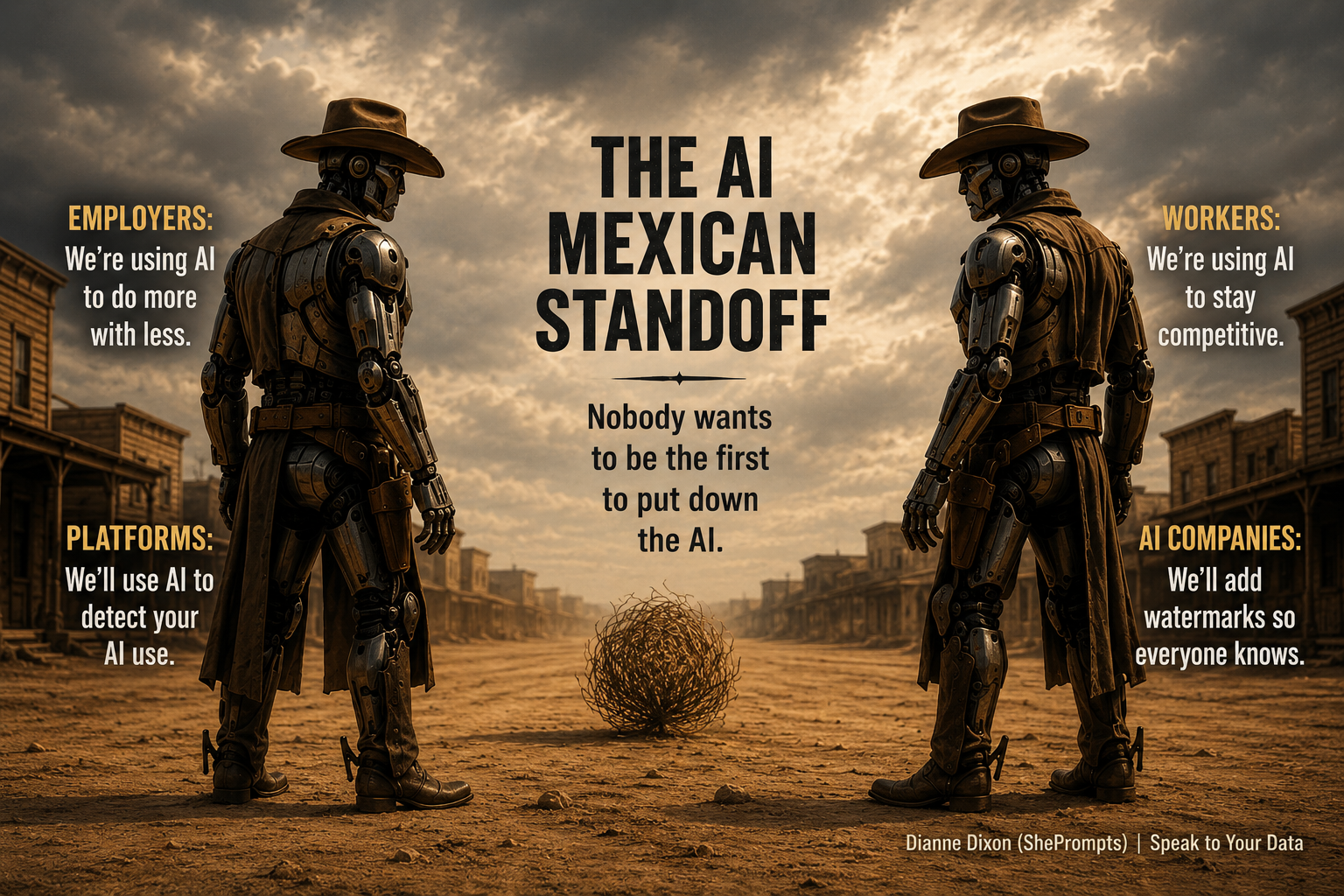
At this point, we've arrived at what I can only describe as the AI Mexican standoff.
And everybody is standing there looking at everybody else like: Don't move.
Nobody wants to put down the technology and everybody wants everyone else to put theirs down first.
But Here's What I Actually Care About
I'm not interested in hiding the fact that AI helped me especially when I’ve wanted something like it for years. I'm interested in whether there was something worth saying in the first place.
That's a very different standard.
I can use AI to help me write something completely generic, derivative, and useless. That's the slop we see and shake our heads about.
I can also use AI to help me take an original observation, investigate it, challenge it, structure it, research it, and communicate it more effectively, thereby creating potentially useful content.
The machine being involved doesn't magically determine which one I've produced. The thinking does.
We Need to Stop Confusing the Tool With the Work
This is the part of the AI conversation that’s continuously disturbing.
We're becoming obsessed with whether AI was involved in producing something, but what are we actually trying to measure?
Originality? Accuracy? Expertise? Authorship? Copyright compliance? Authenticity? Search manipulation? Quality?
Those aren't the same thing and some of those things are so abstract that they make no sense.
An AI watermark doesn't answer all of those questions but it answers a much narrower one: Was AI likely involved in producing or processing this?
That's useful information but it doesn’t score quality, originality, or expertise. And it certainly isn't a measure of whether the person behind the work actually knows what they're talking about.
Google, Interestingly, Has Been Saying Something Similar
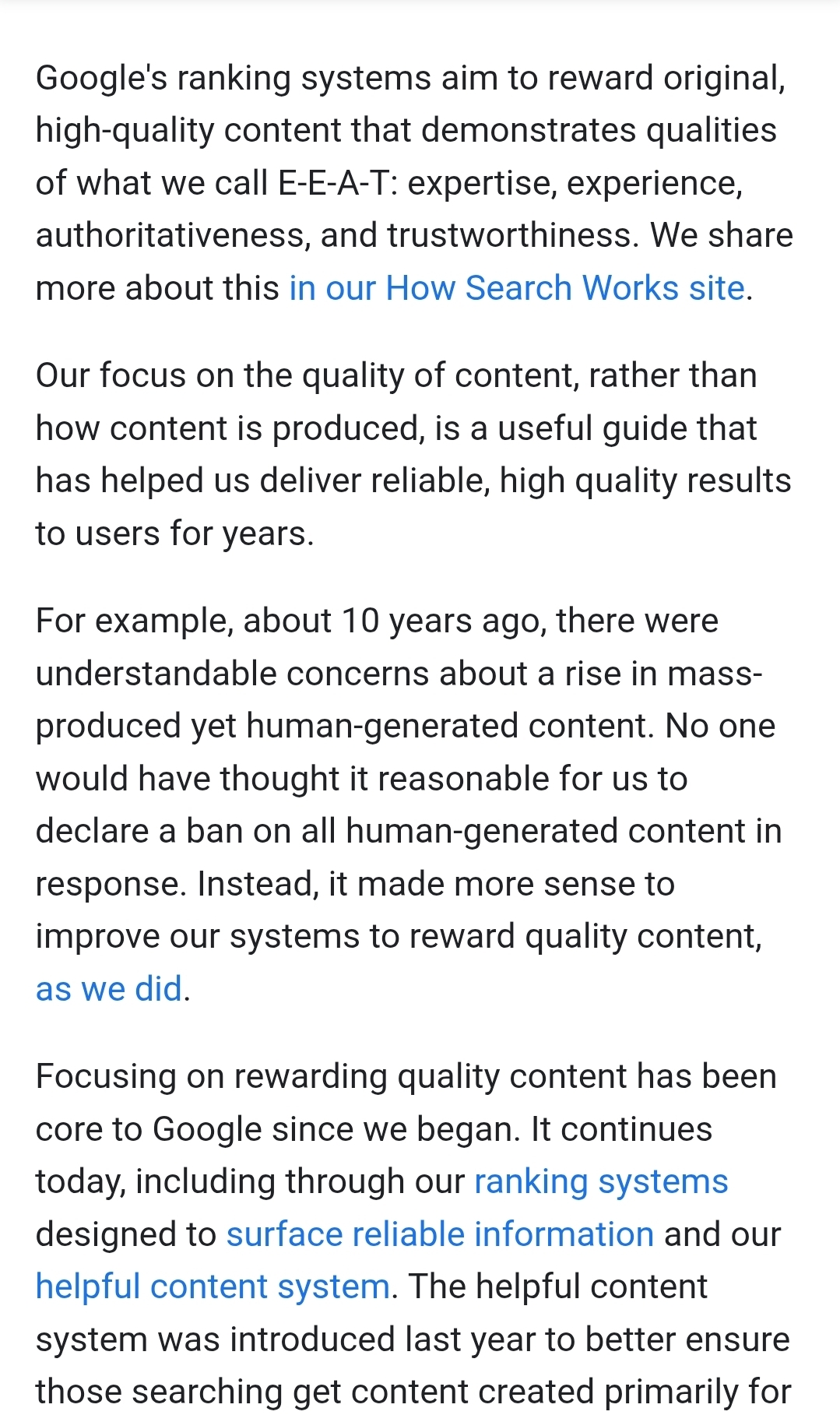
This is also why Google's guidance on AI-generated content caught my attention.
Google's position isn't simply "AI-generated content is bad." Its guidance emphasizes the importance of high-quality content, however it’s produced, while warning against using automation primarily to manipulate search rankings or mass-produce content that provides little value.
That's a much more sensible distinction that bypasses the tired question of, "Did AI make this?" to a better question, "Is this useful?"
Let’s be clear, I’m absolutely not defending AI slop. I'm defending AI as a tool for people who actually have something to contribute. There's a difference.
I Don't Want to Beat the AI Detector
This is where I draw my line.
I'm not interested in spending my time learning how to make my writing look sufficiently "human" so an algorithm gives me a passing grade. (Goodhart’s Law strikes again!)
I don't want to reverse-engineer detection systems or to rewrite perfectly good sentences just because a machine might decide they look suspicious.
I want to make better points, investigate better questions, build things, learn stuff, publish ideas that are actually mine. And if AI helps me do that faster? Good. That's what the tool is for.
So What If You Know I Used AI?
Maybe that's the question I keep coming back to.
I'm not hiding it. I'm not embarrassed by it. I'm not trying to pass off a button press as expertise.
I'm using a powerful tool to multiply my own effort and that's where I think the conversation needs to go.
It’s not about, “How do we make sure nobody can tell AI was involved?" or "How do we make sure everyone knows AI was involved?"
It’s about, "What meaningful human contribution happened here?"
Did somebody bring expertise? Experience? Judgment? Actual research? Proprietary information? A genuinely interesting question? A useful perspective? Did somebody actually think?
Because if the answer is yes, I'm having a hard time understanding why I should be ashamed that a machine helped me get the idea from my head to the page in a coherent manner.
The Commodity (The Button)
Pushing a button to publish whatever comes out without judgment, expertise, or original inquiry. Everyone has the button now.
The Real Moat (The Thinking)
Humans who know how to think with AI. Bringing judgment, experience, research, and genuine perspective to multiply human effort.
The future of content isn't going to be human versus AI. It's going to be humans who know how to think with AI versus people who simply push the button and publish whatever comes out.
And everyone has the button now, but the button isn't the moat. The thinking is.
So yes, I use AI.
Now tell me: Was it worth reading and having an opinion about?