
Analysis by E.H. Bradford
AI Industry Reporter & Reality Correspondent
AI Marketing Automation: Wins, Wipeouts, and What Actually Works for Solo Creators
AI marketing automation is creating two very different realities right now: quiet compounding wins for some, and reputation-wrecking failures for others. This is the story of how both happen—and what that actually means for a solo creator trying to build reliable, recurring cashflow.
Hook: When "Hands-Off Marketing" Turns On You
Picture two small online businesses starting 2025 with the same goal: "let's finally get serious about automated marketing."
The first, a niche outdoor-gear store, adds an AI recommendation engine to its Shopify site and plugs in a few behavioral email flows—abandoned cart, post-purchase, and simple product recommendations. Six weeks later, their average cart size is up double digits, repeat orders tick up, and the tool has already covered its cost.
The second hooks an AI "sales assistant" into their email and CRM, turns on large-scale cold outreach, and watches meetings spike for a few weeks. Then deliverability collapses, reply rates flatline, and their main sending domain starts getting sent straight to spam—even for loyal subscribers.
The tools aren't the real difference here; the strategy is. And for a creator business like yours, that's the line between automation as leverage and automation as a liability.
Investigation: What I Dug Into (And Why You Should Care)
Most marketing advice treats AI like an automatic upgrade: plug it in and your funnel magically becomes "data-driven" and "always-on." The real question is less glamorous and far more important: does AI automation actually compound your revenue and time, or does it just add complexity and new ways to burn trust?
To get a clear picture, I went hunting at three levels. First, real case studies where AI-powered automation moved numbers that matter—conversion rates, cart size, ROI—for small and mid-size businesses, not just enterprise giants. You can see examples in resources like the SuperAGI small-business case library at SuperAGI's case studies and SMB roundups such as Skywork's revenue growth reports.
Second, I studied post-mortems on AI-driven failures, especially in cold email and over-automated sequences that tanked inbox placement or fatigued audiences. Those stories show up in deliverability breakdowns and critical essays like Rui Nunes' "AI Cold Email Is Killing Cold Email" and cold-email analytics from providers that have sifted through millions of messages.
Third, I looked at updated ROI and adoption stats for small businesses to see whether the bright spots are rare outliers or a repeatable pattern. Recent surveys of marketers using AI in 2025 indicate the vast majority lean on it to generate content faster, uncover insights more quickly, and make decisions faster—signs that, when it works, AI lets them do more with the same time and audience.
What emerges is not "AI is good" or "AI is bad," but something more practical: AI works incredibly well when it's plugged into a clear, existing strategy and breaks down when it's treated like a shortcut to skip the hard parts.
Findings: Where Automation Delivers—and Where It Breaks
Story 1: The quiet compounding wins
For Jordan Craig, an apparel small business, the shift started with something most creators already have but underuse: lifecycle email. They adopted a platform that combined AI-driven "next order" predictions, recommendations, and automated flows tied to key moments—welcome, cart, and post-purchase.
Instead of blasting the same newsletter to everyone, their system began sending different messages depending on what customers browsed, bought, and clicked. A first-time buyer who hadn't returned might get a reminder keyed to an AI-predicted reorder window; a lapsed customer might see a tailored comeback offer; someone who abandoned a cart would see a reminder featuring the exact item they left behind.
Over six months, that orchestration delivered a big jump in email-driven revenue, a shorter sales cycle, and a higher share of sales coming from existing customers instead of just new traffic. AI didn't replace their marketing; it multiplied the value of the attention they already had.
Story 2: When cold email automation poisons the well
On the other side of the spectrum, a sales team plugs an AI SDR into their stack, configures a few basic personalization tokens, and tells it to go find meetings. What used to take human reps days—researching accounts, drafting messages, scheduling follow-ups—now takes minutes, and soon they're sending thousands of emails a week.
At first, they see a bump: more opens, a few extra calls booked, enough to feel like the tool is working. But as volume ramps and personalization thins, the data takes a harder turn. Analyses of large cold email datasets show reply rates can drop by more than an order of magnitude when personalization is sacrificed for speed and volume, and open rates have been sliding year over year as inboxes flood. In some breakdowns of cold outreach, over 90 percent of emails now get no response at all.
Behind the scenes, deliverability is quietly collapsing. Shared sending infrastructure means one customer's aggressive behavior can drag down inbox placement for everyone, and shortcuts around warmup, authentication, and domain management make recovery slow and painful. For a brand-driven creator, the painful part is that once your domain is flagged, your best content gets stuck in the same penalty box as your worst automation experiment.
Story 3: "AI pilot" enthusiasm meets real-world failure rates
Zoomed out, the numbers are a mix of promise and friction. Industry analyses suggest AI-powered marketing efforts can deliver average returns in the three-to-five-times range, with top performers seeing even higher ROI when AI is used for targeting, optimization, and customer service. At the same time, broader enterprise reports have flagged that a large majority of generative-AI pilots fail to reach meaningful, scaled deployment.
The gap usually isn't raw technology; it's fit and follow-through. Small businesses that win with AI marketing describe phased rollouts tied to specific KPIs—cart size, time saved per week, lead-to-opportunity conversion—rather than vague "innovation" projects. The ones that struggle often underestimate integration complexity, data quality needs, and the human oversight required to keep automations aligned with brand and audience expectations.
For a solo entrepreneur, that means the real risk isn't missing the AI wave; it's sinking weeks or months into setups that never earn back your time or your list's trust.
Reality Check: How It Helps vs How It Hurts
Here's a side-by-side view of the main plays, grounded in these stories and the data behind them.
| Area | How It Helps When Done Well | How It Hurts When Done Wrong |
|---|---|---|
| AI recommendations and triggers | Learns from behavior to send timely nudges and tailored suggestions—abandoned cart reminders, "you might also like" blocks, and reorder prompts. In case studies, this kind of personalization has lifted cart size and repeat purchases without needing more traffic. | Feels random or pushy if data is thin or tagging is sloppy. People get irrelevant suggestions, tune out your emails, or unsubscribe faster, and the "smart" system quietly trains them to ignore you. |
| AI lifecycle analytics and agents | Continuously tests subject lines, timing, segments, and channels, shifting budget into what actually works and cutting acquisition costs. When tied to clear KPIs, this is where some businesses see three-to-five-times returns. | Over-optimizes for the wrong metric—cheap clicks, vanity opens—and kills experiments that needed more time to prove value. You end up chasing noisy dashboards instead of buyers who stick around. |
| AI-assisted email sequences | Speeds up drafting and testing of welcome, nurture, and sales flows while leaving tone and structure under your control. You ship more experiments and keep your writing energy for the pieces that really need your voice. | Left unattended, can drift off-brand, repeat itself, or stack too many messages back-to-back. That shows up as fatigue, spam complaints, and a creeping sense that "your" emails don't sound like you anymore. |
| AI cold email at scale | In small, highly researched batches, can help brainstorm angles and tighten copy for targeted outreach, especially if you do the work to build a sharp list and clear offers first. | Mass-sending generic templates destroys reply rates, wrecks deliverability, and lands you in the huge majority of emails that never get a response. Your future launches pay the price for last quarter's "set it and forget it" test. |
| "One-click" full-funnel tools | Template funnels can give a solid starting skeleton when you already know your audience and are willing to customize deeply. Think of them as scaffolding, not a finished building. | Promised "fully automated" funnels often don't match messy real-world lists. You can spend weeks wiring everything up only to discover the flows don't resonate and the ROI never shows up. |
Action Plan: A Minimum-Viable Automation System for a Solo Creator
Step 1: Pick one outcome for the next 60 days
For the next two months, choose a single primary outcome: grow your email list with people likely to buy, increase sales of one flagship digital product, or book more qualified calls and strategy sessions.
Anchoring on one outcome keeps you from building clever automations that look impressive in a diagram but never move a metric you care about. It also makes it much easier to decide whether a new AI tool is genuinely helping or just adding noise.
Step 2: Build two or three small, high-leverage automations
Start where the evidence is strongest and the build is realistic for one person.
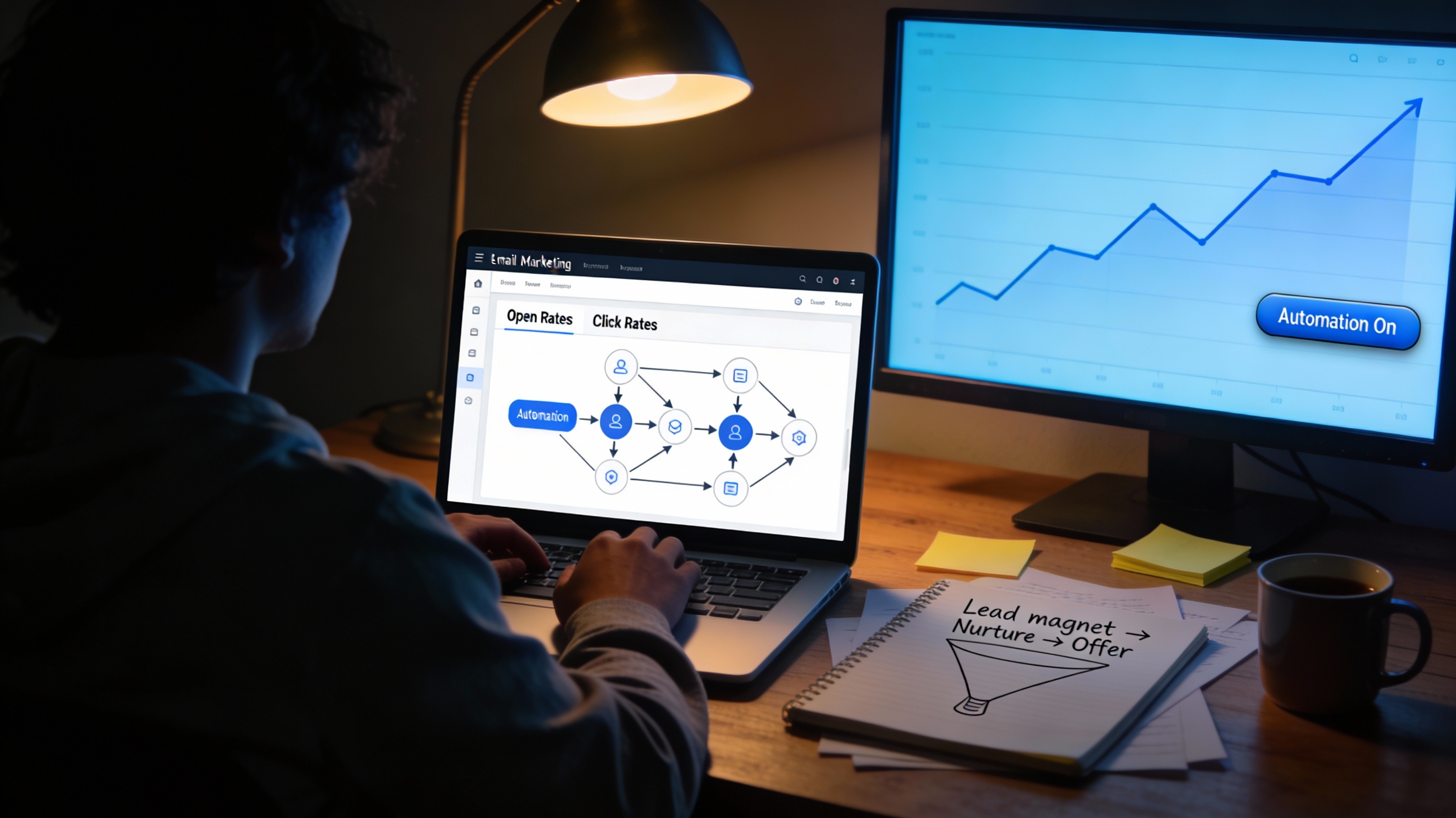
First, connect each lead magnet to a short, tailored nurture path. When someone grabs a specific download, they enter a three-to-five-email sequence that deepens the same topic and points to one clear next offer. You can use AI inside tools like MailerLite's AI assistants or ConvertKit's AI helpers to brainstorm subject lines and drafts, but you still decide the story and give everything a human edit.
Second, set up basic behavior-based tags and offers. Tag people when they click on pricing, visit your sales page, or download a resource tied to a specific product, then connect those tags to small follow-up sequences that speak directly to that interest. AI-powered segmentation and scoring can suggest who looks most likely to buy next, but you choose the timing and tone.
Third, build simple "almost bought" recovery flows. If someone visits a checkout or sales page but doesn't buy, send a short, time-spaced sequence: a reminder, an FAQ, maybe a story that addresses a common objection. This is where many case studies show some of the cleanest lifts in conversion without needing more traffic or ad spend.
Step 3: Protect your domain like it's your passport
Before chasing any kind of "AI scale," lock in basic email hygiene. Warm up new sending domains and IPs gradually if you plan to increase volume, and make sure SPF, DKIM, and DMARC are properly configured so inbox providers can trust your messages. Reputable email platforms and guides from providers like Mailgun or Postmark walk you through the details.
Just as importantly, avoid tools or tactics that encourage sending thousands of cold emails from your main brand domain. If you experiment with outbound at all, keep it highly targeted, send from separate infrastructure, and measure results ruthlessly. Your sending domain is an asset; once it's damaged, everything from launch campaigns to collaboration announcements has to fight through that penalty.
Step 4: Run a simple monthly ROI and sanity check
Once a month, take ten minutes and ask four questions about your automations:
How many hours did this save me this month compared to doing it manually? How much did these tools cost me this month? What revenue or measurable uplift can I reasonably link to these flows—extra sales, higher cart value, more booked calls? Do these automations still feel on-brand and respectful to the people receiving them?
If something isn't clearly earning its keep—financially or reputationally—simplify it, adjust the targeting, or shut it down and redirect that energy to the flows that are pulling their weight.
Bradford's Take: How to Use This If You're Tired of "Just Hustle Harder"
If I were running your business, I'd treat AI marketing automation less like a magic wand and more like a series of small gears you add to a machine you already know how to drive. I'd ignore anything that promises full autonomy and instead focus on one thing per month: another place where your audience has already raised their hand and where a tiny, thoughtful automation can meet them.
The opportunity right now isn't to be the most automated creator in your space; it's to be the one whose automations feel like a natural extension of your voice instead of a noisy, generic bot. Do that consistently, and AI stops being another shiny object—you get a living, evolving marketing system that keeps earning while you're writing the next piece, building the next product, or finally taking a real day off.
Sources & Further Reading
- AI-Powered Marketing Automation Case Studies (SuperAGI)
- How SMBs Are Growing Revenue With AI Tools (Skywork)
- AI Cold Email Is Killing Cold Email (Rui Nunes)
- Why 98% of Cold Emails Fail (Mailpool)
- AI in Marketing Statistics: How Marketers Use AI in 2025 (SurveyMonkey)
- AI Marketing Automation: The Ultimate Guide for 2026 (Improvado)
- The Future of Marketing Automation and Predictive Analytics (SuperAGI)
- Small Business AI Adoption Statistics 2025 (USM Systems)
- AI Marketing Stats to Take Into 2026 (Digital Marketing Institute)
- Which AI Marketing Tools Give the Best ROI for SMB E‑Commerce? (Emerge)
📢 Found this AI marketing automation analysis helpful?
Share Bradford's reality-check guide with fellow creators and small business owners:
Loading recommendations...