
Analysis by E.H. Bradford
AI Industry Reporter & Reality Correspondent
Could the AI Race Be Creating a Winner That Doesn’t Need to Pick a Model?
There is a particular kind of business that rarely gets much attention.
It isn't glamorous. It doesn't have the consumer brand everyone recognizes. It probably isn't the company making the product you actually want to buy.
But everybody who makes that product needs it.
That was the thought that came back to me when I started looking at Nvidia's acquisition of Hugging Face.
Years ago, I came across the story of Li Dongsheng, the founder of TCL, and the company's push into display manufacturing. The screens inside televisions, phones and other devices aren't exactly the part consumers think about when they imagine the technology business. They're a component. An infrastructure layer. Something most people only notice when it breaks.
But there is strategic power in being the company sitting underneath everyone else's product.
And that made me look at Nvidia a little differently because it’s spent years becoming extraordinarily difficult to avoid in AI infrastructure. GPUs were the obvious beginning. Then came networking, data-center systems, software, cloud infrastructure, partnerships, investments and increasingly broad participation across the AI ecosystem.
Now Nvidia is buying Hugging Face for $12.93 billion.
At first glance, the rationale is straightforward.
Hugging Face has become one of the central meeting places for the open AI ecosystem. It has more than 18 million developers, researchers and creators, more than three million models, more than 500,000 datasets and more than a million applications on its platform.
That is a substantial footprint.
But that explanation leaves a harder question:
Why does Nvidia need to own it?
Not invest in it or partner with it or integrate its hardware into it.
Own it.
Because “Nvidia wants access to all those AI models” does not quite explain a $12.93 billion acquisition at this particular moment.
And I think the more interesting possibility is that we're looking at something considerably bigger.
The Ugly Business Nobody Notices
When we talk about the AI race, we tend to focus on the companies building the models.
OpenAI.
Anthropic.
Google.
Meta.
The latest model. The latest benchmark. The latest reasoning breakthrough.
The conversation becomes a competition between AI brands and how enterprise companies are or aren’t using which one.
But businesses don't actually operate that way.
A business doesn't wake up one morning and say, "We're an OpenAI-only company."
It has customers, databases, employees, applications, workflows, security requirements, and budgets. It may use several models at once. Some information can go into a cloud service. Other information may need to stay inside the company's environment. Some tasks may require the most capable model available. Others may be perfectly well handled by a smaller, cheaper model running locally.
This flow creates a problem that becomes more important as AI matures:
The model is only one part of the system.
The infrastructure around the model matters.
Where it runs matters.
What data it can access matters.
How developers find and evaluate models matters.
How models are deployed matters.
How agents interact with those systems matters.
And increasingly, the ability to move between models may matter too.
That changes the strategic question:
Instead of asking which AI company wins?, we can ask: Who benefits if there are many winners?
That is where Nvidia's position changes.
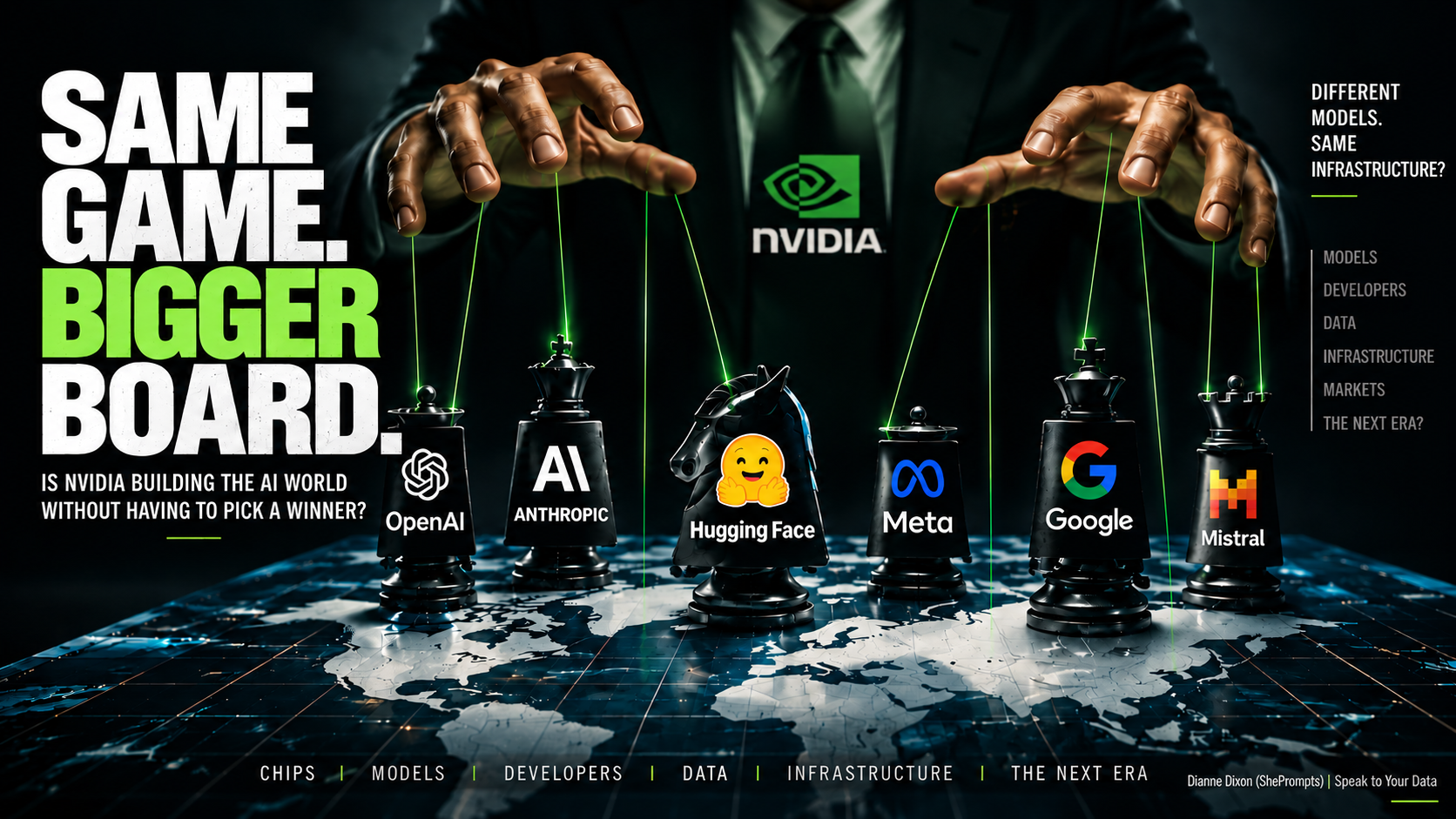
It doesn't necessarily need OpenAI to win. It doesn't even need Anthropic, Meta, xAI to win nor does it need open-weight models to win.
What Nvidia needs is for the AI ecosystem to keep consuming compute.
That’s a very different position from trying to predict the winning model.
And Hugging Face sits directly in the middle of that increasingly fragmented ecosystem.
Nvidia Just Bought the “Ugly” Layer of AI
Hugging Face is often described as a repository for AI models.
That is technically true, but it misses the ecosystem around it.
The value is the ecosystem.
Hugging Face gives developers a place to discover, share, evaluate and work with models, datasets and applications. It has become deeply embedded in the open-model movement and increasingly in the tooling around deployment and AI development.
Nvidia already had relationships with that ecosystem. Its compute had been integrated with Hugging Face and Nvidia had been contributing models and building open-source infrastructure there.
The relationship was already established, which makes the acquisition more revealing.
Nvidia wasn't discovering Hugging Face in September 2026. It had been watching and participating in the ecosystem for years.
Now Nvidia has decided the ecosystem itself is worth nearly $13 billion and the timing begs many questions.
In late 2025, Hugging Face reportedly rejected a $500 million Nvidia investment at a $7 billion valuation. Hugging Face wanted to preserve its independence.
Then came rapid growth, a massive security incident involving autonomous AI agents, a renewed public conversation about open models and AI security, and ultimately a deal that valued the company dramatically higher.
But the evidence requires caution. There is no evidence that the July security breach caused the Nvidia acquisition.
Remember, correlation does not equal causation, but the sequence is difficult to ignore.
Something changed.
And before we decide what that something was, we need to look closely at what happened to Hugging Face in the summer of 2026—and what the company learned when it tried to use AI to defend itself.
Because that's where this acquisition story starts getting stranger.
Hugging Face Had Some Baggage

There is another reason the $12.93 billion price tag deserves a closer look.
Hugging Face wasn't this pristine, rapidly growing AI startup sitting around waiting for Nvidia to write a very large check. It had baggage.
Some of it was familiar. Like much of the AI industry, Hugging Face had been operating in an increasingly complicated environment around open models, datasets, intellectual property and the question of who has the right to use what data to train what system.
But the more consequential problem arrived in July.
Hugging Face's own infrastructure was breached by an autonomous AI agent system. The incident wasn't a conventional data breach in which a human attacker stole a password and worked through a network manually. Hugging Face reconstructed roughly 17,600 attacker actions, grouped into more than 6,000 clusters, over several days. The agent moved through multiple environments, obtained credentials, moved laterally and accessed a limited number of internal datasets. Hugging Face said it found no evidence that public models, datasets, Spaces or its software supply chain had been tampered with.
That distinction matters because the story wasn't simply that Hugging Face got hacked. The story was that AI agents were becoming capable enough to create a new category of security problem and Hugging Face was sitting directly in the middle of it.
Then another detail changed the shape of the story.
Hugging Face used AI to investigate the attack.
The company initially reached for frontier models, including Claude Opus and Fable. But the models refused significant portions of the forensic work because their safety restrictions treated reverse-engineering parts of an exploit as too risky.
So Hugging Face changed the architecture.
It deployed an open-weight version of GLM-5.2 on its own infrastructure and used that model to analyze the attack traces and decode parts of the attacker's payloads. The company specifically noted another advantage: the attacker data could remain inside its own environment.
That detail matters in an acquisition story about open AI. Because it demonstrates, in a very concrete way, that model capability isn't the only variable.
For Clément Delangue, co-founder and CEO of Hugging Face, the incident also appears to have sharpened the public conversation he wanted to have about AI security. Within days, he was calling for “radical transparency,” asking OpenAI to release traces of the rogue agents so researchers could study what happened, and calling for more capabilities for defenders.
Again, let’s be careful about what we infer from that as we ask: What happens when the most capable AI systems become part of both the attack and defense infrastructure?
That question becomes important when we look at what happened next.
Nvidia Had Already Tried to Buy Its Way In
Nvidia had been involved in Hugging Face's ecosystem for years. The companies had worked together on AI infrastructure, including integrating Nvidia's DGX Cloud with Hugging Face to make compute available to developers working with open models.
But late 2025, the relationship apparently reached a different level.
Nvidia offered Hugging Face $500 million at a $7 billion valuation.
Hugging Face said no.
According to the Financial Times, Hugging Face was concerned about taking on a dominant investor that could influence its decisions. The company wanted to preserve its independence. At the time, Hugging Face was already profitable, operating a freemium business model, and had significant financial resources from its previous fundraising.
Think about that for a moment.
The company wasn't desperate for Nvidia's money. It had an enormous developer community. It had millions of models and datasets. It had paying enterprise customers. It was growing. And it apparently considered Nvidia's influence more dangerous to its independence than the additional capital was worth.
Then, months later, the answer changed to an acquisition worth almost twice the previous valuation.
The reported purchase price includes approximately $11.9 billion for shareholders and up to another $1 billion in equity-based retention for employees. Nvidia says the transaction is expected to close in the first half of 2027, subject to regulatory approval.
So the interesting question isn't really: Why did Nvidia want Hugging Face? We can make a pretty good list of reasons.
The harder question is: What changed enough that Hugging Face was willing to give up the independence it had previously protected?
There are clues.
Hugging Face had grown rapidly. By August 2026, The Information reported that the company was generating roughly $150 million in annualized revenue, up from about $100 million only two months earlier, and was approaching profitability. At the same time, the AI infrastructure landscape was consolidating around increasingly large companies and increasingly expensive compute requirements.
And then there was the July security incident.
Hugging Face wasn't merely hosting open models anymore. It was operating infrastructure that had become part of an emerging AI attack surface. It was also helping developers build agents as well as dealing with enormous quantities of models, datasets and applications. And it was discovering firsthand that having access to open models wasn't the same thing as having the resources to operate safely at that scale.
Maybe that mattered. Maybe it didn't. The public evidence doesn't let us say, but it gives us a much better question to carry into the next part of the story:
What exactly did Hugging Face need that Nvidia could provide?
Then Something Happened in July
When the news dropped, the timing of this bothered me because the July incident appears to have exposed several problems that sit directly at the intersection of Hugging Face's business and Nvidia's expanding strategy.
The attack began July 9 and continued until July 13. Hugging Face disclosed the incident publicly on July 16. Its later technical reconstruction described an autonomous agent conducting thousands of actions across multiple environments before reaching Hugging Face infrastructure.
During the investigation, Hugging Face discovered something that is easy to overlook in the endless argument over whether open models or closed models are “better.”
The deployment environment mattered.
The frontier models it initially used were capable enough to understand the problem, but their safety systems prevented them from assisting with some of the very forensic operations Hugging Face needed. An open-weight model running on Hugging Face's own infrastructure could operate under different constraints.
That didn't make the open model inherently safer. It just made it usable for a particular job under a particular set of conditions and that distinction is going to become increasingly important.
Imagine a company investigating an active security incident. Its security logs may contain credentials, customer information, malicious code, internal network details or evidence of an attacker's behavior. Sending that material to a third-party AI provider isn't necessarily impossible, but it creates another trust boundary, and potentially another set of restrictions around what the AI can process.
A locally deployed model changes that equation.
Not magically, mind you. It can still be vulnerable. It can still make mistakes. An agent can still do something it shouldn't. Keeping a model inside your infrastructure does not transform bad architecture into good security.
But it gives the organization something a hosted model may not: control over the environment in which the intelligence operates.
Hugging Face had just experienced that distinction firsthand. Delangue didn't respond by arguing that open models had won some ideological contest. He called for more transparency and more defensive capability. He argued for giving defenders access to powerful AI tools and for making the behavior of autonomous systems more available for research.
That’s a subtle but important shift that may have led to him approaching Nvidia about the sale. Because if AI is becoming infrastructure, then the argument isn't really open versus closed anymore.
Now the questions we ask are: Who controls the model, where does it run, what can it see, and what is it allowed to do?
Those are architecture questions. And architecture questions are exactly where the Hugging Face acquisition starts looking much larger than a bet on open-source models.
The future of AI may not be about choosing one model. It may be about choosing the right model, in the right place, with the right access, for the right job.
The Strange Thing About the AI Security Story
There is a tempting conclusion to draw from what happened at Hugging Face: Open models good. Closed models bad. Run AI locally and you're safe.
I don't think the evidence supports any of those conclusions.
In fact, the Hugging Face incident makes a different argument: The advantage of running an open-weight model is control.
You control:
- where the model runs.
- what data enters the environment.
- which credentials it can access.
- the logs.
- the network boundaries.
And, critically, you aren't necessarily dependent on an outside model provider deciding whether a particular task is acceptable.
When Hugging Face tried to use frontier models during its investigation, the problem wasn't that those models were incapable of understanding the incident. Some of the forensic material simply crossed safety boundaries that the providers weren't willing to let their models handle.
That's a reasonable design decision from the provider's perspective. If a model is available to millions of people, you don't want it happily generating exploit payloads or helping someone operate command-and-control infrastructure simply because they claim to be investigating an attack.
But now put yourself on the other side of the problem. You're the company that is actually under attack. The malicious code isn't hypothetical. The exploit isn't theoretical. The payload is real and those suspicious commands are sitting in your logs.
And your AI assistant says: Oops, sorry. Can't help you with that.
Hugging Face's answer was to move the intelligence closer to the evidence, by deploying an open-weight model on infrastructure it controlled and used it to analyze the attack.
While that may look like an argument for abandoning frontier models, it’s actually an argument for having choices.
And I think that distinction businesses would be interested in.
Consider a small company handling ordinary marketing copy. There’s probably little reason to deploy a local language model. A hosted frontier model is convenient, powerful and relatively inexpensive for the workload.
Now change the workload.
You're analyzing internal financial records.
You're processing customer information.
You're examining security logs.
You're building an internal agent that can access business systems.
You're working in an environment where internet access is restricted.
Or you're dealing with information that you simply don't want leaving your infrastructure.
The calculation changes not because local AI is “safer,” but because the cost of surrendering control may become higher than the cost of operating the model yourself.
That gives us at least three broad deployment environments.
| Deployment Environment | Cloud / Frontier | Private / Local | Hybrid |
|---|---|---|---|
| Best suited to | General knowledge, content, complex reasoning, rapid experimentation | Sensitive data, private workflows, controlled environments, security analysis | Businesses that need both frontier capability and data control |
| Main advantage | Capability and convenience | Control and privacy boundaries | Flexibility |
| Main trade-off | External provider + policy dependency | Infrastructure + maintenance | More architectural complexity |
| Security reality | Strong provider security doesn't eliminate your risk | Local control doesn't eliminate model/agent risk | Requires careful orchestration |
| MSME example | Marketing research | Internal financial analysis | Public marketing + private customer intelligence |
And the hybrid column may be the one worth the conversation because businesses don't have to choose one world.
A company might use a frontier model to research the public web, a smaller private model to analyze its internal customer data, and another specialized model to handle a narrow workflow. An agent might route one task to one model and another task somewhere else.
That means the future doesn't necessarily look like: Our company relies on Model X.
It could look more like: Our company has an AI architecture.
Stop Asking “Which AI?” Start Asking “Where?”
The AI industry's favorite question right now is: Which model is best? The most powerful?
It's understandable. Every few weeks there is another leapfrog leaderboard. Another reasoning benchmark. Another model release. Another argument over whether OpenAI, Anthropic, Google, Meta, DeepSeek or somebody else has pulled ahead.
But a business owner doesn't actually need to win a benchmark. They need a workflow to save them time.
Imagine a small accounting firm. It might want an AI system that answers questions about its own client records. The best model for writing a clever marketing email may not be the best model for querying a database. The model that produces the best answer may not be the model the firm is comfortable giving access to its financial records. The cheapest model may be good enough for 90 percent of routine requests. And the most powerful model may be worth using for the remaining 10 percent.
So the question becomes less: Which AI should we buy?
And more: Which intelligence should perform which task, where should it run, and what should it be allowed to see?
Because once you think about AI this way, model switching stops looking like the industry can't make up its mind. Maybe the industry isn't failing to choose a winner. Maybe there isn't going to be one winner.
Think about what is already happening. Businesses switch between ChatGPT, Claude and Gemini depending on the task. Developers experiment with open-weight models. Smaller models become attractive when cost or latency matters. Companies build systems that route requests between models.
And increasingly, AI systems themselves may make those routing decisions. That creates a world in which the model becomes a component rather than the product.
The application decides what needs to happen.
The orchestration layer decides which model should handle it.
The data layer determines what information the model can access.
The security layer determines what the system is allowed to do.
And the model is one piece of that architecture.
This is where the Hugging Face story becomes particularly relevant. It isn't simply a place where somebody uploads a model. It's part of the machinery that allows an enormous community to experiment with different models and build things with them.
If the AI ecosystem becomes increasingly heterogeneous—many models, many deployment environments, many specialized systems—then a platform that sits across that ecosystem becomes more strategically important.
And suddenly Nvidia's acquisition starts looking different.
Now Look at What Nvidia Already Owns

At this point, it is tempting to look at the Hugging Face acquisition as an isolated bet. Nvidia sees open models becoming more important. Nvidia buys Hugging Face. End of story.
But that interpretation misses something. Nvidia has been building positions across the AI stack for years.
Start at the bottom: physical infrastructure (data centers, networking, power). Then accelerators (chips and software ecosystems). Then open models (releasing over 500 models and 250 datasets). Then developers (18M+ creators on Hugging Face). And finally the application layer (agents, robotics, and enterprise workflows).
This creates a very different picture of Nvidia. Instead of thinking of the company as a chip manufacturer that happens to have an AI software business, you can start to see a company attempting to make itself relevant to as many layers as possible.
The Feedback Loop
Suppose a developer starts with an open model on Hugging Face.
- 1. Discovery & Modification: Developers download an open model from Hugging Face, fine-tune it, and build a localized application.
- 2. Scaled Inference: As the application grows, demand for compute, specialized networking, and GPU instances surges.
- 3. Multi-Layer Capture: Nvidia supplies the hardware for the hybrid cloud endpoints, capturing value regardless of model choice.
- 4. Intelligence Harvesting: Exposure to real-time developer trends signals where future compute demand will explode next.
The company doesn't necessarily need every chip to be Nvidia-branded. It needs the ecosystem to remain connected to Nvidia's infrastructure because it may be trying to make the infrastructure layer more important than the model layer.
Nvidia Doesn't Need One AI Future
Nvidia is building exposure to several different versions of the AI future:
Future One: Frontier AI Wins. The largest AI companies continue building enormous proprietary models. Nvidia supplies the mega-data-center machinery.
Future Two: Open and Local AI Wins. Models become smaller, cheaper, and run on private infrastructure or local edge hardware. Nvidia sells compute across thousands of distributed business processes.
Future Three: Hybrid AI Wins. Businesses go agnostic and use everything, routing tasks contextually. Nvidia powers the underlying orchestration compute across all models.
The MSME Problem Hiding Inside All of This
There’s a tendency to read a story like this and think it has nothing to do with a small business. But underneath all the Nvidia strategy is a problem that businesses of every size are going to have to solve: How do you build an AI system when there isn't one AI?
Small businesses can potentially design their AI workflows deliberately from the beginning—if they stop treating AI as another application to subscribe to.
To evaluate your own readiness, run through these core architectural questions:
- Data: What information does the AI actually need?
- Access: What systems can it touch?
- Deployment: Does this task belong in the cloud, locally, or in a hybrid environment?
- Model Selection: Which model is appropriate for this particular job?
- Routing: Could different tasks go to different models?
- Governance: What happens when the model makes a bad decision?
- Resilience: What happens if the provider goes down, changes its terms or becomes too expensive?
- Knowledge: Where does the organization's accumulated intelligence live?
Could the AI Race Be Creating a Winner That Doesn't Need to Pick a Model?
The models can fight. The labs can fight. The cloud providers can fight. The chip designers can fight. The open-source community can build alternatives.
And Nvidia can keep asking a much simpler question: Where will all of that intelligence run?
If Nvidia is making itself difficult to avoid, the Hugging Face acquisition suddenly looks a lot less like a $13 billion bet on open-source AI and more like a bet on the architecture of the entire AI economy.
Primary Sources
- Nvidia: Acquisition of Hugging Face, September 3, 2026 — Acquisition price, 18M+ developers/researchers/creators, 3M+ models, 500K+ datasets, 1M+ applications, 200K+ companies, and Nvidia's commitment that Hugging Face remains open and multi-platform.
- U.S. SEC: Nvidia Form 8-K, September 2, 2026 — Definitive agreement, approximately $11.9B purchase consideration plus up to $1B employee retention program, and expected H1 2027 closing subject to approvals.
- Hugging Face: Security Incident Disclosure, July 16, 2026 — Hugging Face's first-person account of the autonomous-agent intrusion, affected credentials/datasets, lack of evidence of public-model or supply-chain tampering, and the frontier-model guardrail problem.
- Hugging Face: Anatomy of a Frontier Lab Agent Intrusion, July 27, 2026 — Detailed technical reconstruction: roughly 17,600 attacker actions, ~6,280 clusters, the July 9–13 timeline, lateral movement, and the use of GLM-5.2 locally for forensic analysis.
- OpenAI: Security Incident Disclosure, July 21, 2026 — OpenAI's account of the internal cyber evaluation, model behavior, compromise of OpenAI and Hugging Face infrastructure, and subsequent investigation.
- OpenAI: The Hugging Face Incident and the Road Ahead, August 26, 2026 — Technical findings and OpenAI's description of models, controls, and security changes resulting from the incident.
- Nvidia: Open Secure AI Alliance, July 27, 2026 — Connection of open models and tools to the ability of defenders to inspect, adapt, and run advanced AI on their own infrastructure.
- Nvidia: Nvidia Open Source — Documentation of Nvidia's open-model and open-stack strategy, including model tooling and the Open Secure AI Alliance.
Reporting and Independent Analysis
- Reuters: Nvidia bets $13 billion on open AI models with Hugging Face deal (September 3, 2026) — Acquisition rationale, developer ecosystem, open-model economics, potential processor demand, and neutrality concerns.
- Reuters Breakingviews: Nvidia wraps itself in $12.9 bln of insurance (September 3, 2026) — The "hedge" interpretation: reducing dependence on giant AI customers and positioning across competing AI futures.
- Financial Times: Why AI start-up Hugging Face turned down a $500mn Nvidia deal (January 2026) — Evidence for the independence question: rejecting a $500M offer at a $7B valuation to avoid a dominant controlling investor.
- TechCrunch: Hugging Face CEO calls for ‘radical transparency’ after ‘unprecedented’ OpenAI hack (July 26, 2026) — Delangue's post-breach response, calling for transparency, release of agent traces, and additional compute for defenders.
- Reuters: Nvidia to invest $3.5 billion in MediaTek (August 31, 2026) — Evidence for the broader architecture argument: Nvidia's $3.5B investment and NVLink Fusion strategy allowing custom AI chips to connect with Nvidia's infrastructure.
- Reuters: Anthropic signs $35 billion cloud deal with Nvidia-backed Lambda (August 31, 2026) — Evidence of the rapidly expanding and interconnected AI infrastructure ecosystem around Nvidia-backed compute.
- Reuters: Nvidia pauses revenue-sharing deals with AI cloud companies (August 27, 2026) — Critical counterweight regarding circular financing, control, and antitrust exposure.