
Analysis by E.H. Bradford
AI Industry Reporter & Reality Correspondent
The Hidden Overhead of AI: Why Small Businesses Are Managing More Tools Than Ever
The conversation around artificial intelligence usually revolves around the things we can easily measure.
How much does a subscription cost?
How many tokens did a project consume?
How much did the company save by automating a workflow?
Those are reasonable questions, but they may not be the most important ones.
Over the last few years, AI tools have become part of daily operations for millions of freelancers, consultants, creators, and small business owners. Tasks that once required hours can now be completed in minutes. Research can be accelerated. Content can be drafted quickly. Images, videos, presentations, and reports can be generated faster than ever before.
For small businesses in particular, that’s a remarkable advantage. A solo founder can now access capabilities that would have required a team only a few years ago.
But while discussions about AI often focus on visible costs, another cost has quietly emerged in the background. It’s not always reflected on a credit card statement, and it rarely appears in ROI calculations.
It’s the cost of managing the AI itself.
Not because AI is failing or because the technology isn’t useful. But because every new capability introduces new decisions, new processes, and new responsibilities.
For many small businesses, the real story isn’t simply automation. It’s the creation of an entirely new layer of operational overhead.
The Costs Everyone Notices
Most conversations about AI spending focus on direct expenses.
Subscriptions.
API credits.
Token usage.
Premium plans.
Enterprise licenses.
These costs are easy to understand because they’re visible. They appear as line items on invoices and monthly statements. It’s also why discussions around AI economics frequently focus on tokens. The more you use a system, the more you consume. The more you consume, the more you pay.
That logic makes sense.
Yet focusing exclusively on direct costs can create a blind spot.
And time, for a small business, is usually the scarcest asset on the table.
That’s the part a lot of hype cycles skip over. They talk about the affordability of the tool, but not the cost of organizing the tool, training around the tool, supervising the tool, and fixing the mess when the tool is half-right instead of fully right.
The Rise of AI Administration
Every technology creates some amount of management work.
Email required inbox management.
Social media required content management.
Websites required content updates and maintenance.
AI is no different despite the constant ‘set it and forget it’ hype that’s out there.
What makes AI unique is how quickly that management layer can expand into the equivalent of employee shadow work. A typical small business owner today might use multiple AI systems throughout the week:
One for writing.
Another for research.
A third for image generation.
A fourth for video creation.
Perhaps a fifth for automation.
Each tool has its own strengths, weaknesses, pricing model, interface, updates, and learning curve. None of this is necessarily bad. In fact, it reflects the growing maturity of the AI ecosystem.
The challenge is that someone has to coordinate it all. Someone has to decide:
Which model produces the best results?
Which subscription is worth keeping?
Which workflow should be updated?
Which new feature is worth testing?
Which outputs can be trusted?
Which outputs need additional review?
In a large organization, these responsibilities may be distributed across departments. In a small business, that responsibility usually falls to one person. The owner.
What began as a productivity tool can gradually become another management function. And that’s where the hidden overhead starts showing up. Atlassian’s 2026 survey points to a clear version of this problem: AI can increase speed for individuals while leaving teams stuck with the same coordination bottlenecks, creating what it calls a “fragmentation tax”. That’s not just corporate jargon; it’s the everyday reality of work piling up at review, approval, and decision points.
The Productivity Paradox Reappears
Technology history is filled with examples of tools that promised productivity gains but initially created complexity.
Economists have long discussed what became known as the productivity paradox. Businesses invested heavily in technology, yet the expected productivity gains did not always appear immediately. The problem wasn’t that the technology lacked value. The problem was that organizations had to learn how to use it effectively.
Workflows changed.
Processes changed.
Expectations changed.
The same pattern appears to be emerging with AI.
Consider a simple example. A consultant writing a client report ten years ago may have followed a straightforward process: Research. Write. Edit. Deliver.
Today the process may look very different:
Research with AI.
Compare outputs from multiple models.
Upload supporting documents.
Generate drafts.
Refine prompts.
Fact-check claims.
Review citations.
Format outputs.
Then deliver.
The final report may be better. The process may even be faster, but it is also more complex. Some of the labor has been removed, while some has simply been relocated.
Instead of spending all their time creating, professionals now spend a portion of their time managing systems that assist with creation. That distinction matters.
Atlassian’s latest report makes the same point from a different angle: most teams are using AI more, but leaders are struggling to measure real organization-wide returns, because faster individual output gets trapped by reviews, approvals, and coordination bottlenecks. In other words, the speed gain is real, but the system around the work often hasn’t changed enough to absorb it.
When Efficiency Creates More Work
One of the more interesting side effects of AI adoption is that efficiency often changes expectations.
When content creation becomes faster, businesses tend to create more content. When research becomes easier, businesses tend to conduct more research. When reports become easier to generate, businesses tend to generate more reports.
The result is that productivity gains can become partially absorbed by increased output requirements.
A creator who once published one article per week may now feel pressure to produce an article, a newsletter, multiple social media posts, video content, and supporting graphics—all from the same source material.
The technology makes this possible, but it also expands the scope of what is considered normal. This is not necessarily a negative outcome. Greater output can create greater opportunity. The important point is that increased efficiency does not automatically translate into reduced workload.
Sometimes it simply changes the nature of the workload.
That’s especially true for small businesses, where “we can do more now” quickly becomes “we should do more now.” And once that mindset takes hold, the AI tool stops being a helper and starts becoming a pressure multiplier — more channels, more deliverables, more expectations, same number of hands.
The Verification Problem
Another source of invisible overhead is verification. AI systems are extraordinarily capable, but they are not autonomous experts.
Outputs still require review.
Claims still require verification.
Data still requires validation.
Context still matters.
For a small business owner, this means that AI often shifts responsibility rather than eliminating it.
While a draft can be generated in seconds, a mistake can be generated just as quickly. The faster content is produced, the more important quality control becomes. This creates a subtle tradeoff. Businesses save time during creation but spend time during validation. The balance can still be favorable.
In many cases it is.
However, the validation step represents real work that is frequently overlooked when calculating productivity gains. The time didn’t disappear. It moved.
And in some businesses, it moved into the most expensive part of the workflow: the part where errors touch customers, clients, or the brand itself. Research and analysis pieces have been making this point more bluntly too, arguing that AI gains often get eaten by rework and supervision rather than translating cleanly into ROI.
The Hidden Risk for Small Businesses
Large organizations can often absorb inefficiencies. They have departments, managers, specialists, and support staff. Small businesses rarely have that luxury.
A solo founder operates under a different constraint: Time.
Every hour spent evaluating tools is an hour not spent serving customers. Every hour spent testing models is an hour not spent selling. Every hour spent reorganizing workflows is an hour not spent building products.
That doesn’t mean AI should be avoided. Far from it. Many small businesses are benefiting enormously from AI adoption.
The risk isn’t using AI. It’s allowing AI management to consume a growing percentage of the workday. At that point, the business can find itself optimizing tools rather than outcomes. The goal quietly shifts from solving customer problems to maintaining increasingly sophisticated systems.
That is where invisible overhead begins to matter. This is also where small businesses are more exposed than large firms. They don’t just have fewer people; they usually have less tolerance for workflow drag, fewer checkpoints, and less room for a “good enough” AI process that still needs a human cleanup pass.
The Businesses That Win Will Create Less Overhead
The common assumption is that the businesses using the most AI will have the greatest advantage.
I’m not convinced that’s true. In fact, I’ll go so far as to say that’s absolutely false. We’ve seen plenty of tech examples where more didn’t equal better.
The businesses that benefit most from AI may actually be the ones that manage it most efficiently. They will choose tools carefully. They will simplify workflows whenever possible. They will resist the temptation to adopt every new platform, feature, or trend.
Most importantly, they will evaluate AI based on business outcomes rather than usage metrics.
The question is not: “How many AI tools are we using?”
The question is: “Are we creating more value?”
That’s a very different measurement.
Technology has always rewarded those who understand the difference between capability and necessity. AI is unlikely to be any different.
And there’s a practical lesson buried in that: the winning businesses will not be the ones that automate everything. They’ll be the ones that automate selectively, keep humans where judgment matters, and avoid turning a simple operation into a high-maintenance machine.
AI Overhead Audit
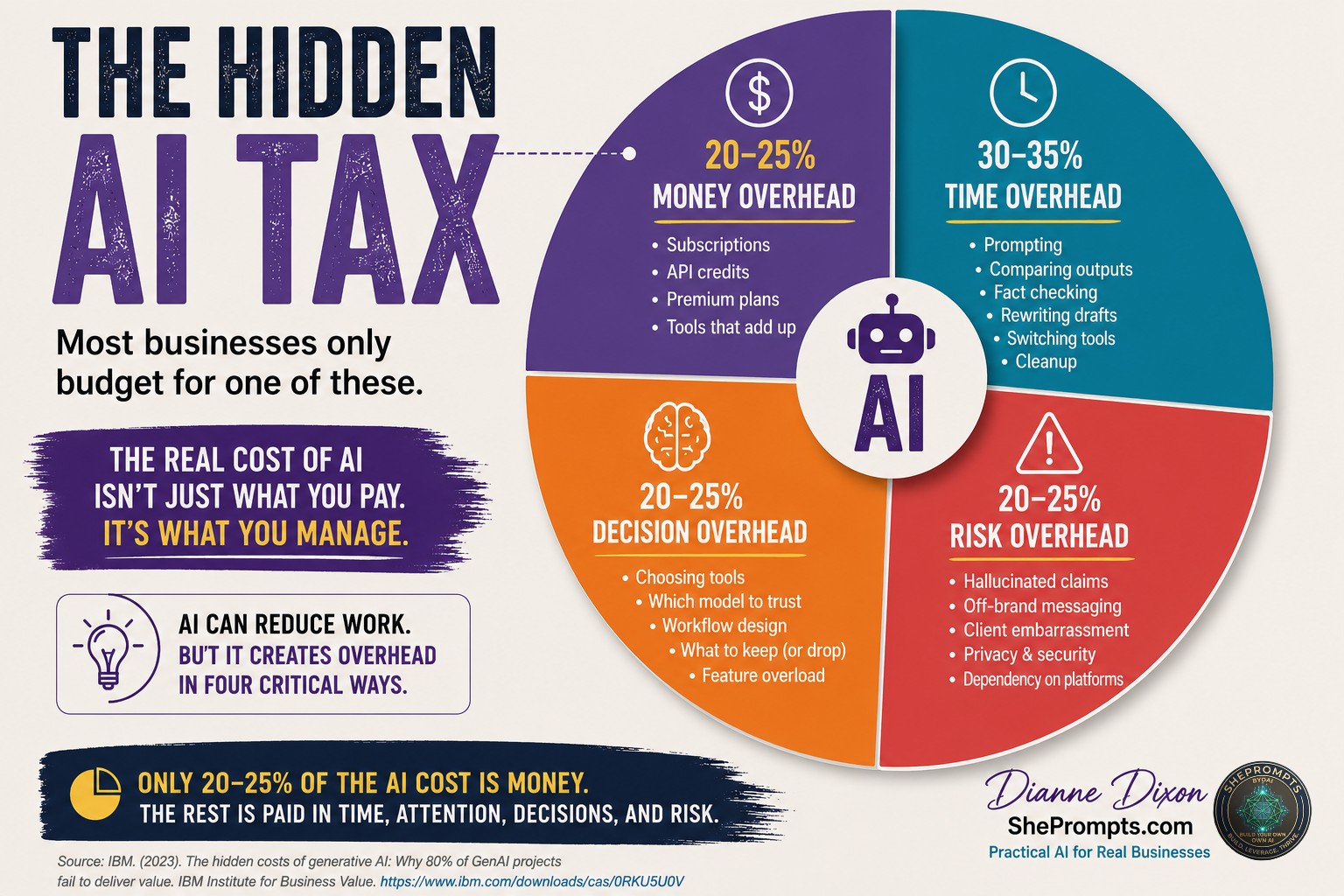
Here’s the part most businesses never map clearly: the overhead that comes with AI. It doesn’t always show up as a bill, but it shows up everywhere else — in time, attention, judgment, and risk. The easiest way to see it is to break it into four buckets.
- 💸 Money overhead is the most visible part: subscriptions, API credits, premium plans, and the little monthly tools that pile up until nobody remembers why they were added. That matters because a cheap tool can become an expensive habit once it is attached to your workflow.
- ⏳ Time overhead is the hidden one: prompting, comparing outputs, checking facts, rewriting drafts, switching between apps, and cleaning up half-finished automation. This is where many small businesses lose the time they thought they were saving.
- 🧠 Decision overhead shows up when the owner becomes the full-time AI manager: choosing which tool to keep, which model to trust, which workflow to rebuild, and which feature to ignore. That is a real cognitive tax, especially for solo operators who already wear every hat.
- ⚠️ Risk overhead is the one most people forget: hallucinated claims, off-brand messaging, client embarrassment, privacy issues, and dependency on a platform that can change pricing or performance overnight. For small businesses, one bad AI mistake can cost far more than a month of subscription savings.
The Real Cost of AI Isn’t Always Financial
The debate around AI often centers on money, as it pertains to subscriptions, tokens and infrastructure. Those expenses matter.
But for many small businesses, the larger challenge may be operational rather than financial.
Every new tool introduces decisions.
Every workflow requires maintenance.
Every output requires judgment.
Every system adds complexity.
None of this means AI has failed to deliver on its promise. If anything, the opposite is true. AI has dramatically expanded what a small business can accomplish.
The opportunity is real.
The productivity gains are real.
The advantages are real.
But so is the overhead.
The businesses that thrive in the next phase of AI adoption won’t necessarily be the ones with the largest prompt libraries, the most sophisticated workflows, or the highest token consumption.
They’ll be the ones that remember why they adopted AI in the first place.
Not to manage more technology. But to create more value. And in the long run, that’s the metric that matters.
Sources & Further Reading
- Atlassian: The AI efficiency paradox
- Forbes Council: Why faster employees don’t equal more productive organizations