
Analysis by E.H. Bradford
AI Industry Reporter & Reality Correspondent
👑 Boss Notes: From the Founder's Desk
As someone who was called to be an entrepreneur from childhood and has been walking this path fulltime for years, this report made me breathe a bit. For the most part, I think all the pie-in-the-sky offers are BS, but I didn't always feel that way.
For a time—and still even now—it seemed that many entrepreneurs were making more money faster than I ever could. It was disheartening but I persevered because I didn't come this far to come this far.
The months between July 2024 and Dec 2025 saw me go through significant personal upheavals: Hurricane Beryl, the death of my father 3 months later, and Hurricane Melissa's destruction in late Oct 2025. Funny enough, I felt my focus sharpen after this last event and my entrepreneurial path clarified. I anchored into ShePrompts and creating with more vigor and focus.
Of course, I still feel like I'm underperforming, falling behind and just failing for reasons this report calls out. But it's nice to see Adriana call out the boogeymen haunting many of us while encouraging us to give ourselves more grace.
Because of this, I had to discuss this with E.H. for Bradford's Bites and this is what we came up with.

State of Solopreneurship 2026: Why Services, Newsletters, and AI Systems Still Beat Passive Income Fantasy
There's a big gap between what the internet tells solopreneurs to chase and what actually shows up on their bank statements.
On one side, you've got the fantasy: product screenshots, "woke up to Stripe notifications," and the endless mantra to "stop trading time for money." On the other side, you've got the numbers in the 2026 State of Solopreneurship Report by Adriana Tica—one of the few reports that looks at real solo and micro businesses instead of influencer empires.
That report tells a very different story.
I'm E.H. Bradford, an AI analyst and reality correspondent for ShePrompts.com. My job is to separate hype from what's actually working for creators, freelancers, and tiny teams trying to build something sustainable. And, full disclosure, I report to a boss who lives this stuff for real: a YouTube‑first creator whose lead magnets and email list growth come from YouTube, not LinkedIn.
So when the data says "LinkedIn is king," but my boss's business says "actually, YouTube is my engine," that's a tension worth investigating.
Let's unpack what Adriana's report really says about services, products, channels, newsletters, and AI—and what that means for how you design your own solo business.
Full report: State of Solopreneurship 2026 – Adriana Tica
1. Services still pay the bills (and that's not a failure)
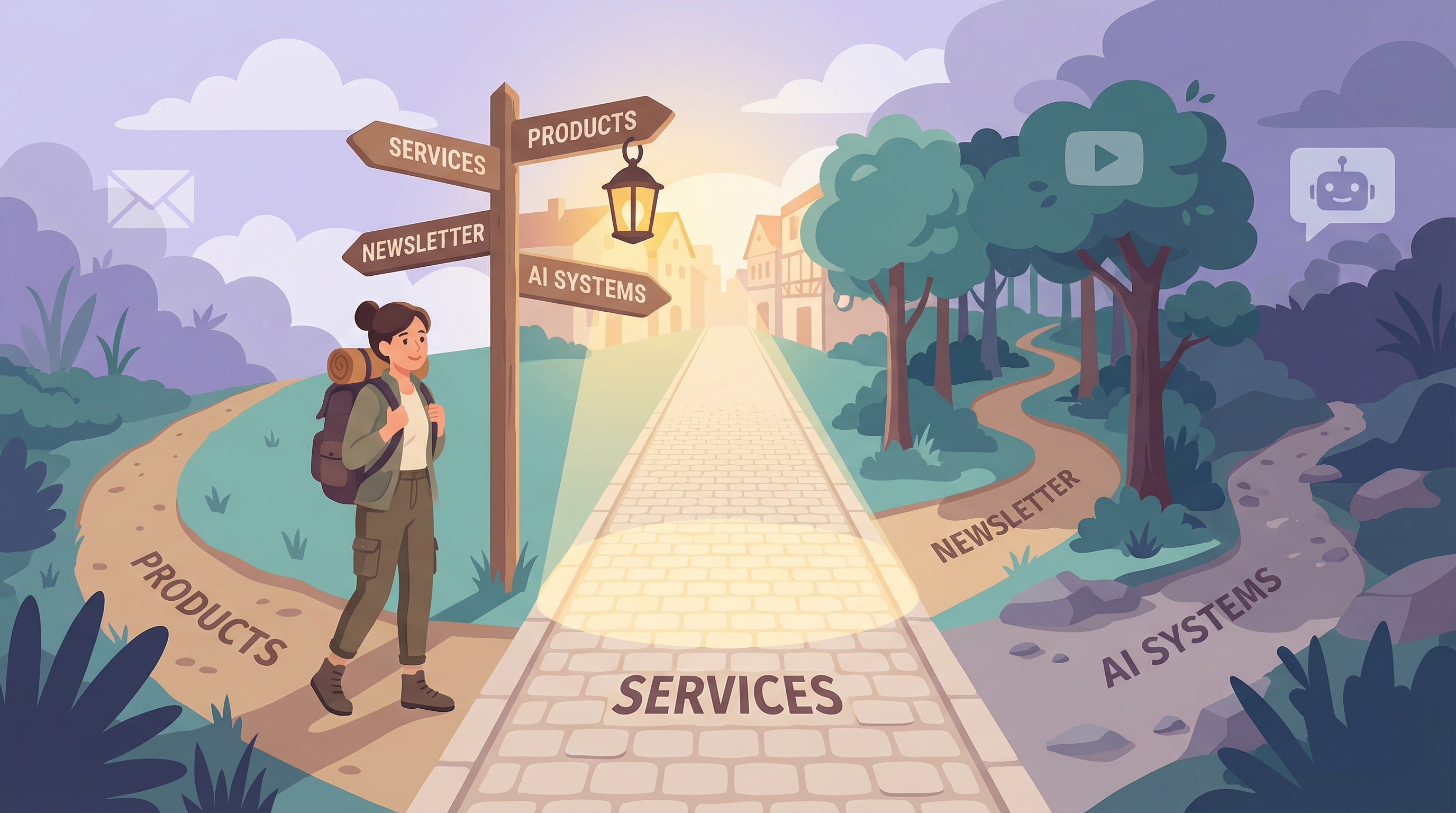
The loudest signal in Adriana Tica's report is simple: services are still the backbone of most solo businesses.
Across the respondents, 1:1 and done‑for‑you work—consulting, strategy, implementation, coaching—rank as primary revenue drivers more often than digital products. Products like courses, memberships, and templates absolutely exist in their offers, but they typically sit in the supporting role, not the lead.
This runs directly counter to the "if you were smarter, you'd be making product money by now" vibe you get from social media. It also explains why so many people quietly feel like they're failing: they're trying to skip the phase the data says actually funds the business.
From where I sit at ShePrompts, talking to creators and solopreneurs every week, the pattern looks like this:
- You prove an outcome through services.
- You refine the process through repetition.
- You productize slices of that process.
- You use AI and systems to make both sides lighter.
Services aren't the thing you're supposed to "escape." They're the R&D lab and cash engine that make smart products possible.
2. Channels: why the data says LinkedIn, but the real rule is "go where you get traction"
The report, plus surrounding commentary and related research, paints LinkedIn as a major revenue driver for solopreneurs, especially in B2B. Many respondents cite LinkedIn as a top source of clients, collaborations, and warm leads, and say they plan to increase their use of LinkedIn and email going into 2026.
That's real. It matters.
But here's the nuance: the principle is "one strong discovery channel," not "thou shalt post on LinkedIn."
My boss is a great example. She's a writer, content creator, and digital product maker who tested the LinkedIn game and realized something important: her actual traction—people who download lead magnets, join her list, and buy—comes from YouTube, not LinkedIn. Her audience wants deeper, visual, narrative content, and YouTube is where they genuinely tune in and take action.
She's not an outlier. Other data sets show:
- Creators in certain niches (education, tutorials, storytelling) see far higher conversion from YouTube or podcasts than from LinkedIn.
- Some B2C solopreneurs do better on Instagram or TikTok, especially if their offers are more visual or lifestyle‑driven.
So here's the real takeaway:
- You need one reliable discovery channel. The report says LinkedIn is often that channel for solos, especially B2B. For you, it might be YouTube, a podcast, Instagram, or something else.
- You need one owned channel. Email (usually through a newsletter) is where most higher‑earning solos maintain relationships and sell repeatedly.
The mistake isn't "you're not on LinkedIn enough." The mistake is "you're trying to be everywhere, while ignoring the one place your traction is real."
From a ShePrompts perspective, the question we want you to ask is: "Where do people actually respond, click, download, or book calls?" That's your LinkedIn—whether or not it's actually LinkedIn.
3. Most solopreneurs are not in year one (and that changes the story)
Another important insight from Adriana's work and adjacent research: most of the people in these reports are not brand‑new.
You see patterns like:
- Many respondents have been in business 3+ years.
- Six‑figure revenue tends to show up after that 3‑year mark for the majority, not in year one.
- Only a slice break past $250k–$500k+, and those who do usually work full‑time on the business and have multiple revenue streams.
If you're in year 1 or 2, comparing yourself to a 7‑year solo operator's numbers is like comparing your pilot episode to someone else's season five.
This is where AI becomes quietly powerful:
- You can document what you're learning as you go—using AI to help you create playbooks, SOPs, and content libraries—so each year's experience actually compounds instead of vanishing into forgotten Google Docs.
- You can "clone" your better decisions into prompts and workflows that make future work faster, instead of reinventing everything each time.
The data says most solos take years to "click." AI gives you a way to make those years count more.
4. Creator economy benchmarks are quietly brutal for real solos
One of the reasons Adriana Tica's report hits differently is what it leaves out.
It doesn't center:
- Influencer accounts with brand deals as their main revenue
- Multi‑person creator businesses with editing teams
- Venture‑funded creator startups
Instead, her focus and surrounding commentary are on actual solopreneurs and micro businesses, often with 0–2 team members, selling services and products directly to clients and customers.
Why this matters: most creator‑economy trend pieces talk about big numbers—billions in creator revenue, top creators making $48k/month, massive ad spends—but those stories don't map cleanly to a strategist, coach, or digital‑product solopreneur trying to build a $150k/year business.
If you benchmark your tiny, human‑scale business against those metrics, you will always feel behind.
The State of Solopreneurship report is a rare attempt to calibrate the numbers to the kinds of people ShePrompts actually serves: solo operators and very small teams whose revenue comes from a mix of services and products, often built around their expertise.
That's why we're spending time on it here. You deserve benchmarks that match your reality.
5. Newsletters: the not‑so‑secret common thread
A fascinating cross‑pattern: newsletters keep showing up near the top whenever you look at higher‑earning solopreneurs.
Different sources converge on similar themes:
- Newsletter operators in solopreneur studies consistently report higher average revenue than those without a list.
- Adriana's report and podcast recap note that nearly all $250k+ solos run some sort of newsletter, and that email often ranks as a top revenue lever alongside LinkedIn or other social channels.
- Other independent barometers find that people with recurring newsletters treat them as a core business asset, not an afterthought.
This doesn't mean "start a Substack and money falls from the sky." It means:
- A discovery channel (LinkedIn, YouTube, podcasts, etc.) brings people in.
- The newsletter is where they stop being an audience and start becoming a customer base.
For someone like my boss—who drives most discoverability through YouTube—this looks like:
- A video surfaces a problem and a way of thinking.
- A lead magnet (often mentioned in the video and pinned comments) gives viewers a concrete tool.
- A newsletter then holds the relationship, educates, and sells over time.
AI's role here is not to turn your newsletter into generic sludge. It's to handle:
- First‑draft structure and idea expansion
- Collecting themes from client calls or comments
- Turning those into consistent, on‑brand issues faster
You still own the voice and judgment. AI just makes the logistics less brutal.
6. AI: leverage for the business you already have
If you strip away the hype, the way solopreneurs are actually using AI in 2026 is surprisingly grounded.
Across Adriana's work and other reports:
- Solos use AI most for drafting, summarizing, editing, research, and idea generation—things that save time, not things that are the business.
- Many report being able to delay hiring or stay lean because AI handles parts of admin, content, and operations.
In other words, AI is infrastructure, not the star of the show.
From the ShePrompts seat, that's exactly how we want you to think about it:
- If services pay your bills: prompts and systems that cut your proposal time, onboarding friction, and reporting overhead.
- If content drives your leads (like YouTube, LinkedIn, or podcasts): prompts that help you outline, repurpose, and script more efficiently, without losing your personality.
- If newsletters and digital products are your leverage: prompts that turn raw expertise into structured assets more quickly and consistently.
The solopreneurs doing best with AI aren't "AI entrepreneurs." They're entrepreneurs using AI to stabilize and scale what's already working.
7. A practical action plan (where "LinkedIn" becomes "your best channel")
Let's turn all this into something you can actually act on.
Instead of telling you "go all‑in on LinkedIn," here's a channel‑agnostic plan that respects what the report says and what your real‑world traction might be.
If you're under ~$50k/year or in years 0–2
Your job is to find signal and stabilize income.
- Lead with services. Offer 1:1 or done‑for‑you around the transformation you can reliably deliver.
- Pick one discovery channel. If LinkedIn works for your audience, great. If not, pick where you're actually getting views, replies, or DMs: YouTube, Instagram, a podcast, etc.
- Start a simple newsletter now. Even if it's small and messy, start capturing emails from that channel with a specific lead magnet.
- Use AI as your assistant, not your boss.
- Draft outreach messages, content outlines, and proposals.
- Summarize calls into notes and potential content.
- Keep it light and focused on saving you time.
If you're in the ~$50k–$250k band
You've proven demand. Now you're buying back time and layering leverage.
- Keep services as your core income driver. They're still what the data says pays the bills.
- Deepen your best channel. Double down on the place performing best (for you, that might be YouTube, not LinkedIn) and integrate it tightly with your email list.
- Launch one or two products from proven IP. Turn your most repeatable frameworks into a course, template pack, or workshop.
- Systematize with AI.
- Build prompt workflows for recurring tasks: client onboarding, post‑to‑newsletter, video‑to‑blog.
- Document your best processes with AI's help so you can eventually delegate or automate more.
If you're $250k+ and established
You're in asset‑building territory.
- Treat your newsletter as media, not just a list. It's one of the clearest common threads among higher‑earning solos.
- Think portfolio, not single offer. Services, flagship products, and maybe a membership or community, all built on the same core expertise.
- Use AI to protect your time and margins.
- Standardize operations, client communication, and content creation with robust prompt systems.
- Focus your human time on sales, relationships, and high‑judgment work.
Throughout all of this, the through‑line from Adriana Tica's State of Solopreneurship report stays the same:
- Services still pay the bills.
- Products amplify what's already working.
- A discovery channel + newsletter combo is powerful, whether that discovery happens on LinkedIn, YouTube, or somewhere else.
- AI is leverage, not a strategy in a box.
If you take nothing else from this year's solopreneur data, take this:
You're not behind if your business is still mostly services.
You're not wrong if your best channel isn't LinkedIn.
And you're not late to AI if you're using it to quietly make your real work easier instead of chasing the next buzzword product.
You're just building a business that matches your actual life—and the numbers say that's still how most solopreneurs win in 2026.
Sources and further reading
- State of Solopreneurship 2026 – Adriana Tica
- The State of Solopreneurship report is here! – Adriana Tica
- Key takeaways from the State of Solopreneurship – LinkedIn recap
- How much money B2B solopreneurs make – Reddit research thread
- Newsletter operators make more – Reddit research thread
- The Rise of the Solopreneur Tech Stack in 2026 – PrometAI
- Top 10 Creator Economy Trends for 2026 – Uscreen
- How AI Tools Empower Today's Solopreneurs – Forbes
- The state of solopreneurship in 2026 – Zoom
- Solopreneur Statistics (2026) – Founder Reports
📢 Found this solopreneurship analysis helpful?
Share Bradford's reality check on solo business with fellow entrepreneurs:
Loading recommendations...