
Analysis by E.H. Bradford
AI Industry Reporter & Reality Correspondent
"Stealable Moves": Real Case Studies From Solo Entrepreneurs Actually Making Money
Most creators and solopreneurs aren't looking for motivation anymore. They're looking for receipts: what's selling, through which channels, and what's actually worth copying into their own business.
What follows are case studies grounded in actual numbers and business models, plus specific moves that can be lifted, adapted, and stress-tested inside a creator or small business setup.
Case Study: The Solo Creator With Seven Revenue Streams
Content creator and educator LaTasha James runs a one-person content business that reportedly brings in more than $500,000 per year in revenue. She has experimented with hiring, decided she prefers operating solo, and rebuilt her business around a lean, creator-led model rather than a traditional agency structure.
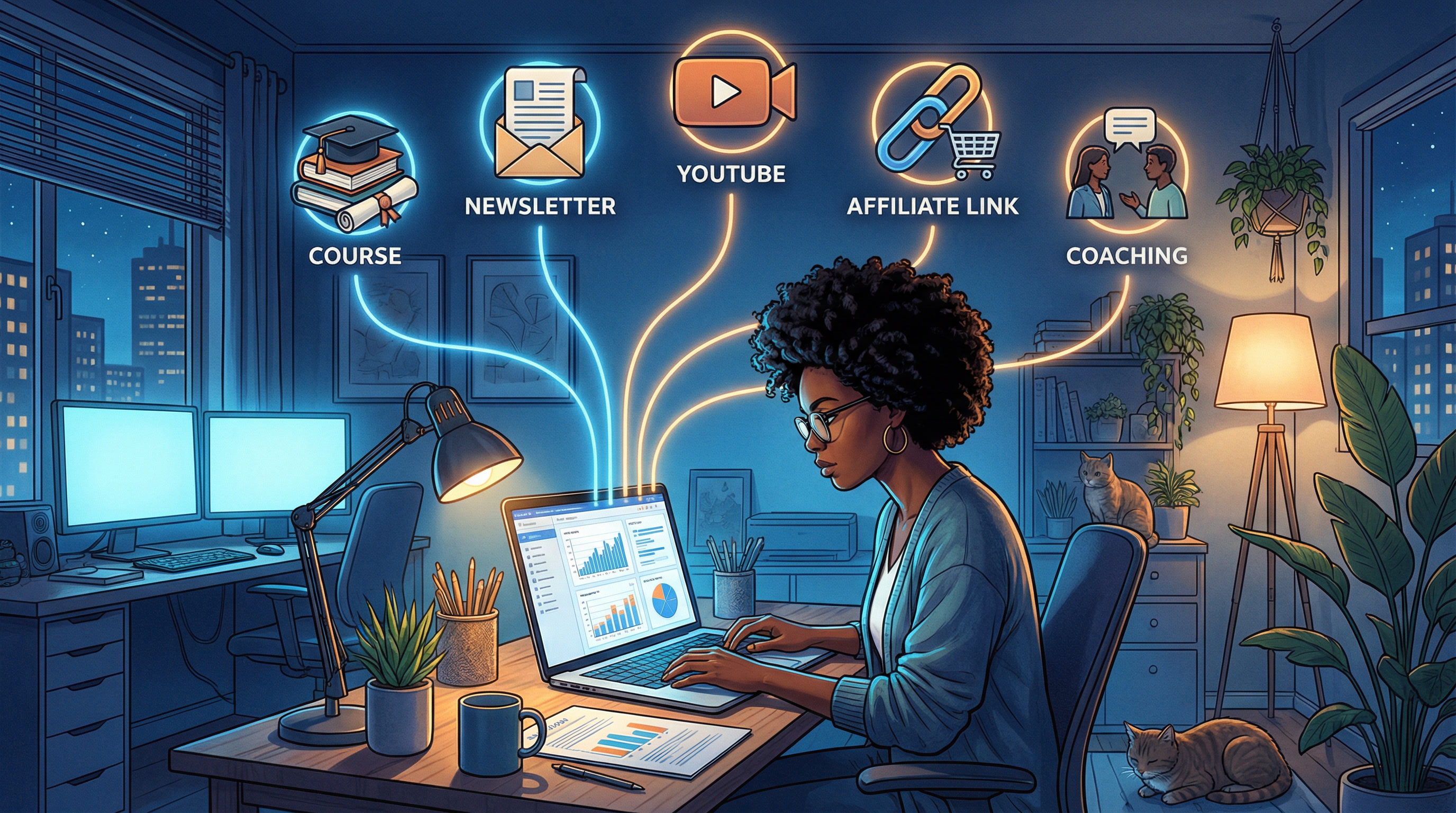
Her income is spread across seven distinct streams that all connect back to her content and expertise:
- Courses – roughly 40% of revenue.
- Brand deals and sponsorships – about 30%.
- Done-for-you client work – 10%.
- Affiliate marketing – 9%.
- YouTube AdSense – 6%.
- Memberships and coaching – 5%.
- Speaking – around 1%.
Courses and brand deals carry most of the weight, while AdSense, memberships, affiliates, and speaking behave more like supporting layers than primary drivers. Behind the scenes, she has also iterated on her membership platform, shutting one version down for six months and then relaunching on a platform that fit her content style better, which underlines how even "small" revenue streams can get attention once the core offers are solid.
Stealable moves
Use platforms as lead engines, not your business model. LaTasha's revenue mix makes it clear that YouTube AdSense is nice but not central; the platform exists to send people into her courses, memberships, and strategic client work, where the real margins live. For creators, that suggests treating algorithms as top-of-funnel distribution rather than the product itself.
Build around one or two "hero" offers. Even with seven revenue streams, the majority of income clusters around courses and brand partnerships, both tied directly to clear outcomes her audience cares about. Instead of chasing dozens of small products, it can pay to design one or two robust offers and let everything else orbit those.
Keep a small, selective service arm. Client work accounts for about 10% of her income and is deliberately limited to long-term, strategic projects she actually wants to be in. For freelancers, this points to a model where services aren't abandoned but upgraded into high-fit, high-leverage engagements that provide cash flow, stories, and real-world data for future products.
Case Study: The Course Creation Blog Doing Around $300K/Year
On a different path, a course-creation blog profiled in a 2024 breakdown has built a business in the low-to-mid six figures, powered mostly by affiliate income plus its own courses. The operator transitioned from tax accountant to full-time blogger, using content as the main engine instead of social virality.
The reported numbers are revealing: the blog generates an estimated $242,000 per year in affiliate commissions, recommending tools such as Leadpages, Canva, ConvertKit, and Bluehost, and then adds course income on top through programs teaching blogging, SEO, and course creation. The site attracts more than 35,000 monthly visitors and has been featured on Forbes, Entrepreneur, and Inc., which helps with authority and organic growth.
The content strategy is straightforward: beginner-friendly blog posts that help aspiring bloggers and course creators get started, with embedded YouTube videos that deepen the explanation and keep visitors engaged longer. Email marketing ties the experience together through a five-day bootcamp and ongoing updates that point readers toward both courses and affiliate recommendations.
Stealable moves
Pick one education hub and own it. This business leans on a focused blog and supportive YouTube channel rather than trying to dominate every platform at once. For creators with limited time, building a single well-organized knowledge hub can produce more reliable revenue than scattered efforts across short-form platforms.
Make affiliates and your own courses work together. Instead of treating affiliate links as an afterthought, the blog intentionally steers readers toward tools they will need as they follow the tutorials, while also offering its own courses as the deeper, more structured option. That dual structure turns each article into both a teaching asset and a sales asset without feeling like a hard sell.
Layer content instead of reinventing it. The same core ideas appear as written guides, videos, and email sequences, each going slightly deeper or addressing a different angle. For small teams, this layered approach is a way to get more mileage out of each idea and keep publishing without burning out on constant reinvention.
Case Study: A Newsletter-First Business With a $105K Cohort Launch
Another documented case shows what happens when a newsletter is treated like a strategic asset instead of a weekly obligation. A newsletter operator launched a live cohort course and generated $105,637 in roughly four days, selling to an email list of about 13,230 subscribers.
The course itself focused on newsletter growth and monetization, distilling the lessons from two years of running a newsletter-focused growth agency. Many prospects wanted help but could not afford full-service retainers, so the cohort became a structured "do it yourself with guidance" alternative, complete with templates, guest experts, and live feedback sessions.
The launch strategy was surprisingly restrained: a few webinars that drew around 2,015 registrations, segmented email campaigns targeting the most engaged subscribers, and a defined Thursday–Sunday enrollment window. Despite leaving some promotional options on the table, last-minute buyers pushed the launch past the original goal of $99,900 and confirmed that a warm, targeted list can outperform a much larger but looser audience.
Stealable moves
Let services inform your product roadmap. In this case, the cohort was essentially the agency's process repackaged for people who couldn't or didn't want to pay agency rates. For freelancers, looking at the patterns inside client work can reveal ready-made course or program ideas that already have proof baked in.
Treat your newsletter like an asset, not a newsletter "to-do." The revenue came not from a huge list but from a relatively focused group of subscribers who had been nurtured with relevant, problem-aware content for years. For creators, that shifts the priority from chasing raw subscriber counts to curating an audience that consistently opens, clicks, and replies.
Design launches as events. The combination of webinars, a tight enrollment window, and a clear outcome gave the cohort the feel of an event, not just a link drop. That kind of "moment" can be replicated on a smaller scale for workshops, live intensives, and hybrid service/product offers.
Case Study: A Flagship Course With a Seven-Figure Launch
At the higher end of the spectrum, creator and solopreneur Justin Welsh reportedly generated around $1.5 million in six days from the launch of his Creator MBA program, using Kit as part of his launch stack. The impressive headline number sits on top of years of publishing content on LinkedIn, Twitter, and via email about building one-person businesses.
The program is framed as a full operating system for creators who want to build leveraged, solo-first businesses, not just a course with a set of videos. That framing, combined with a well-defined audience and clear transformation, supports a premium price point and attracts people who are already sold on the general philosophy before they see the sales page.
Distribution is as important as the product: Welsh's daily posts dissecting his own revenue, systems, and workflows act as ongoing proof-of-work for what Creator MBA teaches. By the time the cart opens, the audience has seen dozens of live examples of the method in action, which reduces hesitation and shortens the decision cycle.
Stealable moves
Build one flagship, then support it. Rather than offering a dozen unrelated products, this model centers on a single, high-impact program and supports it with free content, lower-ticket offers, and occasional live experiences. For creators, that's a reminder that focus can often scale better than a crowded product shelf.
Use content to pre-sell the worldview. By the time people encounter the Creator MBA sales page, many have already adopted key ideas about one-person businesses through months of free posts and newsletters. When content leads with philosophy and proof rather than constant pitching, launches feel more like a natural next step than a surprise ask.
Treat tools as amplifiers, not saviors. Kit and other platforms streamline checkout, upsells, and customer experience, but they sit on top of strong audience–offer fit. For small operators, that's a caution against assuming a new platform will fix a weak offer; the tech amplifies whatever is already there.
Quick Pulse: The State of Solopreneurship
Zooming out, a research project looking at more than 160 solopreneur cases highlights how these stories fit into the broader solo economy. Across that sample, revenue streams cluster around physical products, SaaS, online courses, and niche content sites, with many solo founders stacking multiple types of income at once.
The income distribution is sobering and encouraging at the same time: roughly 41% of solopreneurs in that dataset earn under $50,000 per year, about 23% sit between $50,000 and $100,000, around 29% fall into the $100,000–$500,000 range, and only 7% clear the $500,000 mark. That puts the case studies above in context: mid–six-figure solo businesses exist and are growing, but they are built on compounding work rather than overnight breakthroughs.
For a deeper dive into how founders are actually making money — including offers, channels, newsletters, and AI usage — the State of Solopreneurship 2026 report is a worthwhile read at adrianatica.com/state-of-solopreneurship. It reinforces a recurring pattern from the case studies here: services still pay the bills for many solos, and LinkedIn plus email remains a power combo that a lot of one-person businesses plan to double down on.
Action Plan: Turning Case Studies Into a Practical Stack
Across these stories, one pattern shows up repeatedly: a clear audience, one or two strong offers, and a channel strategy that favors depth over constant novelty. Translating that into something a solo operator or tiny team can actually execute starts with choosing a lane and then stacking revenue streams intentionally instead of by accident.
If you're primarily a writer or educator
Anchor the business around a newsletter and a simple content hub, such as a blog or resource library, where readers can binge your best thinking. From there, develop one "hero" course or cohort that directly tackles the most persistent problem in your audience — for example, getting to a first $1,000 in digital product revenue or turning a newsletter into a client pipeline.
Once that core offer works, layer in affiliate recommendations that genuinely fit the systems you teach, whether that's email platforms, course tools, or AI assistants. Over time, each article and email becomes both a teaching moment and a subtle on-ramp into your flagship product and affiliate ecosystem.
If you sell done-for-you creative or strategy services
Position services as the premium, limited-capacity option while documenting your process in public through content and email updates. As the same client questions repeat, spin them into paid workshops, templates, or a systems-focused course that lets more people benefit from your expertise without requiring your hands on every project.
Over time, nudge new leads toward the productized side first, reserving one-on-one work for higher-budget or higher-fit clients who are ready for a deeper engagement. That shift moves the business from purely trading time for money to a mix where products and services reinforce each other.
If you're a multi-platform creator
Choose one primary platform plus email as the backbone, and let everything else play a supporting role. Then build a flagship product ecosystem — a main program or membership, plus a few add-ons — instead of launching a new low-ticket product every time you have an idea.
When it's launch time, structure the campaign like an event: behind-the-scenes build-in-public content, specific "who this is for" messaging, and a clear timeline with doors opening and closing. That approach can work at modest price points just as well as at premium ones; the principle scales down as easily as it scales up.
Bradford's Take
Most small creators and freelancers overestimate how much they need to invent and underestimate how much they can simply adapt from what's already working. The entrepreneurs in these case studies are not doing anything mystical; they've made a series of fairly ordinary decisions — picking a specific audience, committing to a clear promise, and repeating that promise across products, services, and content until it compounds.
The real opportunity for solo businesses isn't chasing the next shiny model but building a layered, almost boringly effective setup: one primary channel, one flagship offer, a couple of supporting revenue streams, and a habit of measuring what actually makes money. The creativity lives less in inventing new business structures and more in deciding which of these stealable moves to claim, remix, and turn into your own operating system.
Sources & Further Reading
- Case Study: Solopreneur #1 – Latasha James
- Latasha James: Operating Solo Content Business Is Real
- How YOU Can Make $300K/Year from a Course Creation Blog
- How I Launched a Course and Made $105,637 in ~4 Days
- Justin Welsh's Kit Playbook: Creator MBA Case Study
- Research on Solopreneurs: Surprising Findings Behind 160+ Startup Cases
- State of Solopreneurship 2026
📢 Found these solo entrepreneur case studies helpful?
Share Bradford's "stealable moves" analysis with fellow creators and entrepreneurs:
Loading recommendations...</