Dr. Hannah Fry is a brilliant mathematician with a knack for explaining everyday phenomena through science and storytelling. She was the one who introduced me to the idea of the ghost traffic jam. You've probably experienced one.
You're crawling down the highway, convinced there must be a major accident ahead. Traffic stretches for miles. Everyone is braking. Everyone is frustrated. Then suddenly, traffic clears. No accident. No roadwork. No police. Nothing.
The congestion was caused by a small disruption that rippled through the entire system. One driver tapped their brakes. Another reacted. Then another. The slowdown spread backward like a wave until thousands of drivers were sitting in traffic that technically didn't exist. Traffic engineers call this a phantom or ghost traffic jam.
Businesses suffer from the exact same phenomenon. Many business owners look at their operations and conclude that the entire organization is inefficient. Projects are delayed. Customers are waiting. Employees are frustrated. Revenue isn't growing as quickly as it should.
It feels like everything is broken. Usually, it isn't. More often than not, a single constraint is creating a ripple effect that makes the entire business feel congested.
The problem isn't everywhere. The problem is somewhere. And finding that "somewhere" can change everything.
The Most Expensive Business Problems Are Often Invisible
One of the biggest mistakes business owners make is assuming that the loudest problem is the real problem. When deadlines are missed, teams complain. When customers wait too long, support complains. When projects stall, managers complain. The pain shows up everywhere, so it feels like the problem must be everywhere too.
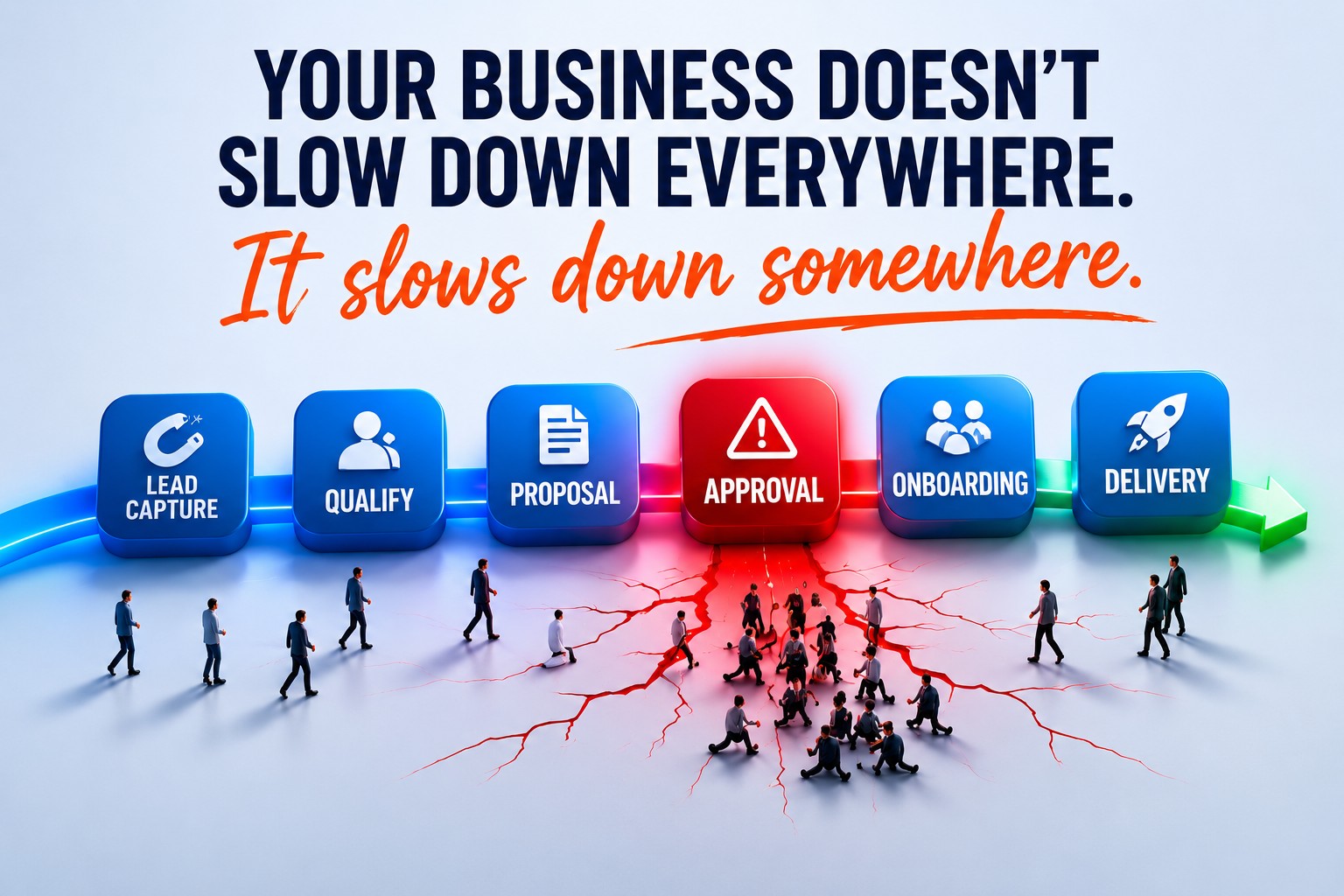
But that's rarely how systems work. In reality, most operational slowdowns can be traced back to a single bottleneck. A bottleneck is any point in a process that limits the flow of work through the entire system. Just like traffic on a highway, the effects spread far beyond the source.
• One overloaded approval process can delay sales.
• One disorganized database can slow down customer service.
• One overwhelmed team member can create weeks of backlog for everyone else.
The bottleneck creates a ripple effect. Upstream teams are blocked waiting. Downstream teams are starved of work. Everyone feels the strain. The bottleneck itself often appears normal because it's constantly busy. Meanwhile, everyone else experiences the symptoms. This is the business equivalent of a ghost traffic jam.
The slowdown isn't happening everywhere. It's happening at one point, and the ripple is making everyone feel the congestion.
YOUR BUSINESS DOESN'T SLOW DOWN EVERYWHERE. IT SLOWS DOWN SOMEWHERE.
The Counterintuitive Truth: The Bottleneck Isn't Where You Think It Is
Most owners instinctively listen to complaints. That's understandable. Complaints are visible. Queues are not. But complaints tell you where pain is being felt. Queues tell you where the problem actually exists.
Tells you where the pain is being actively felt by your team or customers.
Tells you where the problem actually exists and work is stalling.
This leads to one of the most useful principles in operations management: Follow the queue, not the complaint. Work piles up before the bottleneck, not at it. Read that again. Work piles up before the bottleneck, not at it.
FOLLOW THE QUEUE, NOT THE COMPLAINT.
That's the clue most businesses miss. If you're trying to find the source of operational friction, stop asking: "Who's complaining the most?" Start asking: "Where does work sit waiting the longest before moving forward?" That's where your ghost is usually hiding.
The 15-Minute Bottleneck Test
You don't need sophisticated software to begin identifying bottlenecks. Start with three simple observations.
1. Map Where Work Actually Stalls
Look at how work moves through your business. Where does it pause? Where does it wait? Where do requests, approvals, customer records, projects, or tasks start accumulating?
The key isn't how long a task takes to complete. The key is how long it sits waiting before anyone touches it. If work consistently piles up before a specific process but moves quickly after that process is completed, you've likely found your constraint.
2. Ask: Who's Overloaded and Who's Waiting?
Bottlenecks create imbalances. One person or department is drowning in work. Others are waiting.
Look for areas where: One team is consistently overloaded. Other teams have idle time. Projects frequently stop at the same stage. Customers experience delays after a specific handoff.
The goal isn't to find who is busiest. The goal is to find where work is consistently waiting to be processed.
3. Follow the Backlog
Backlogs are evidence. They reveal where demand exceeds capacity. Whenever work accumulates faster than it can be completed, a constraint is forming. Instead of trying to optimize everything, focus on understanding why that backlog exists. The answer often reveals the true bottleneck.
Why Most Businesses Waste Money Solving the Wrong Problem
Here's where things get expensive.
The Sales vs. Onboarding Mismatch
Imagine your sales team can close 30 new clients every month. But your onboarding process can only handle 20. Most business owners react by investing in more marketing. More advertising. More lead generation. More sales activity. It feels logical. But it's completely backwards.
The bottleneck isn't lead generation. The bottleneck is onboarding. Adding more leads only increases congestion.
MORE LEADS WON'T FIX A SYSTEM THAT CAN'T PROCESS THE LEADS IT ALREADY HAS.
The business becomes busier without becoming more productive. Revenue opportunities are lost because the system cannot process what it's already receiving. This happens every day in businesses of every size. Companies buy software when they need process improvements. They hire employees when they need better workflows. They invest in growth before fixing the constraint that's preventing growth from happening. The result is more complexity, more frustration, and more wasted money.
The Five-Step Framework for Eliminating Bottlenecks
The Theory of Constraints, developed by Eliyahu Goldratt and popularized through The Goal, provides a simple framework for improving system performance.
THE GOAL ISN'T TO ELIMINATE BOTTLENECKS. THE GOAL IS TO IDENTIFY THE RIGHT ONE.
The Plot Twist Nobody Expects
Most people assume that eliminating a bottleneck means eliminating bottlenecks forever. It doesn't. The bottleneck moves. And that's actually good news. A moving bottleneck means work is flowing more efficiently through the system than before.
The goal isn't to create a business with no constraints. The goal is to continuously identify and improve the constraint that matters most.
This creates a powerful mindset shift: Don't optimize everything. Optimize the thing that determines everything.
A 10% IMPROVEMENT AT THE BOTTLENECK CAN IMPROVE THE ENTIRE BUSINESS.
A 10% improvement at the bottleneck can increase output across the entire system. A 10% improvement everywhere else may have little impact at all. That's why identifying the right problem matters so much.
A Simple Example
Imagine a content business.
Every day, five articles accumulate waiting for review. The writer feels inefficient because unfinished work keeps piling up. The publisher feels underutilized because there isn't enough approved content to publish. Both experience the symptoms. Neither is the source.
The solution isn't making the writer faster. The solution isn't giving the publisher more work. The solution is improving the editing process. Once editing capacity increases, the bottleneck shifts elsewhere and the cycle begins again.
The Cost of Not Looking
Ghost traffic jams eventually clear themselves. Business bottlenecks rarely do.
⛔ They compound and build deep administrative friction.
⛔ The backlog grows while overall customer response times increase.
⛔ Opportunities slip away and core internal teams become deeply frustrated.
⛔ Owners spend money aggressively solving external symptoms instead of core causes.
A hidden bottleneck doesn't just slow work down. It quietly increases costs, delays revenue, and limits growth. The longer it remains invisible, the more expensive it becomes.
Your Business Is a Highway, Not a Broken Machine
Yet businesses do something similar every day. They overhaul processes. Purchase new software. Hire more staff. Launch new initiatives. All while the real problem remains untouched. The bottleneck continues creating congestion, frustration, and lost revenue.
Your business doesn't slow down everywhere. It slows down somewhere. That somewhere is the ghost traffic jam inside your operation. The invisible constraint creating ripples throughout your entire business.
What's Your Business's Ghost Traffic Jam?
Most business owners know they have delays. Few know where those delays actually begin. If projects are taking longer than they should, work keeps piling up, or your team feels busy without producing more output, there's usually a constraint somewhere in the system creating a ripple effect.
A Workflow Bottleneck Audit helps identify where work is stalling, where revenue is leaking, and which constraint is having the biggest impact on your business. Because before you invest in more software, more people, more automation, or more marketing, it helps to know what's actually slowing the highway down.
The question isn't: "What's broken?" The better question is: "Where does work pile up?" Follow the queue, not the complaint. That's where the ghost is hiding.
Sources for further reading:
- The Goal: A Process of Ongoing Improvement by Eliyahu M. Goldratt
https://www.toc-goldratt.com/en/product/the-goal-a-process-of-ongoing-improvement - Theory of Constraints: A Guide for Better Workflow Efficiency
https://monday.com/blog/project-management/theory-of-constraints/ - Theory of Constraints: 5 Steps Guide
https://www.clearpointstrategy.com/blog/theory-of-constraints-guide - Mathematicians Take Aim at 'Phantom' Traffic Jams
https://news.mit.edu/2009/traffic-0609 - How to Identify and Eliminate Supply Chain Bottlenecks
https://imperiascm.com/blog/identify-and-eliminate-supply-chain-bottlenecks