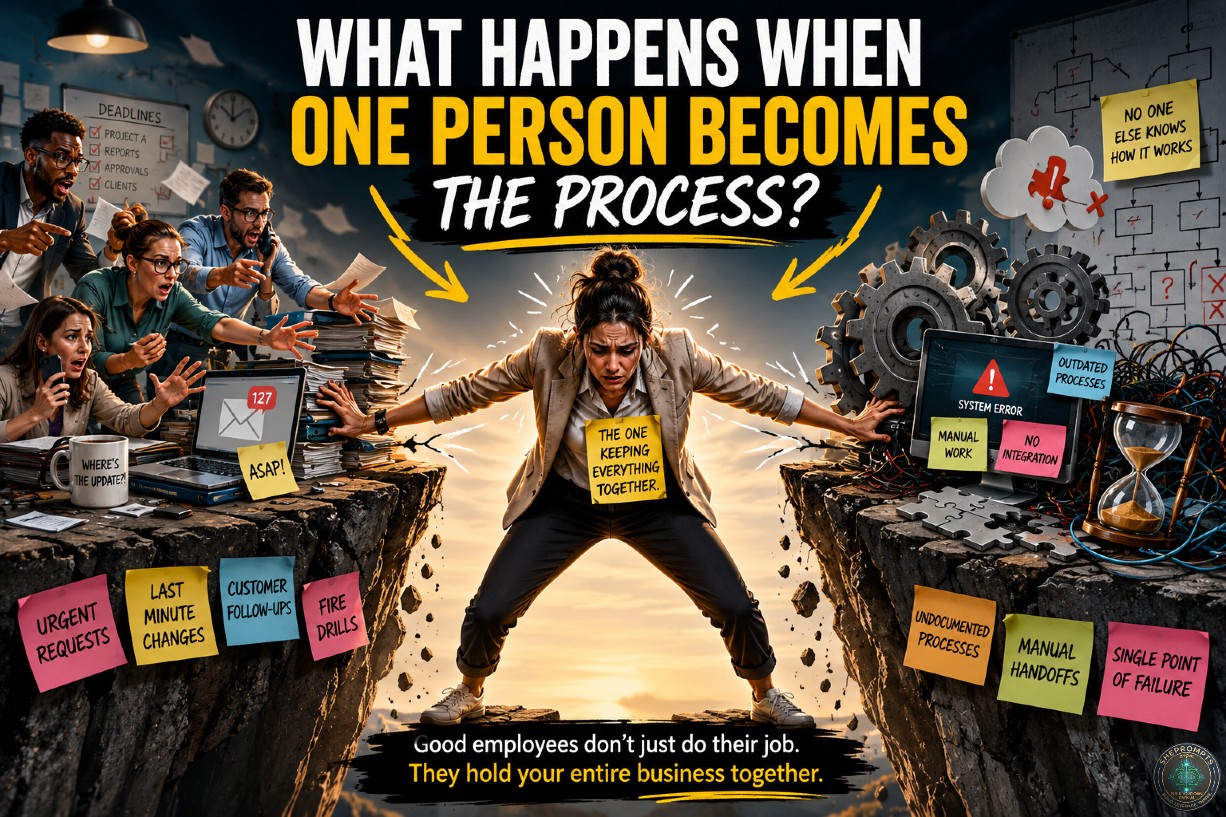
You may have seen that over-the-top comedy sketch (I think it was from The Onion). An employee is getting ready to go on vacation. Her backup is… okay. Sounds insecure. Looks anxious. Within hours of this main employee leaving, the office turns to bedlam. The backup is speaking to her vacationing counterpart, voice shaking, visibly crumbling, screeching: "Yeah, everything is fine, really."
Of course, this is an over-the-top scenario. But it highlights a major problem for businesses. One employee going on vacation leads to struggles—funny in a sketch, terrifying in real life. What looks like job security on the employer side is a frightening scenario on the business side.
When you have that “clutch” employee take their entitled PTO, you’ll have people ask: "Did they usually handle this?" The answer is always yes.
Punchline: That great employee wasn't the process owner. They were the process.
POOR EMPLOYEES EXPOSE BROKEN SYSTEMS. GREAT EMPLOYEES HIDE THEM.
Why Great Employees Are Dangerous
Here's the counterintuitive idea that many leaders miss: Poor employees expose broken systems. Great employees hide them.
Think about it. Your best employee:
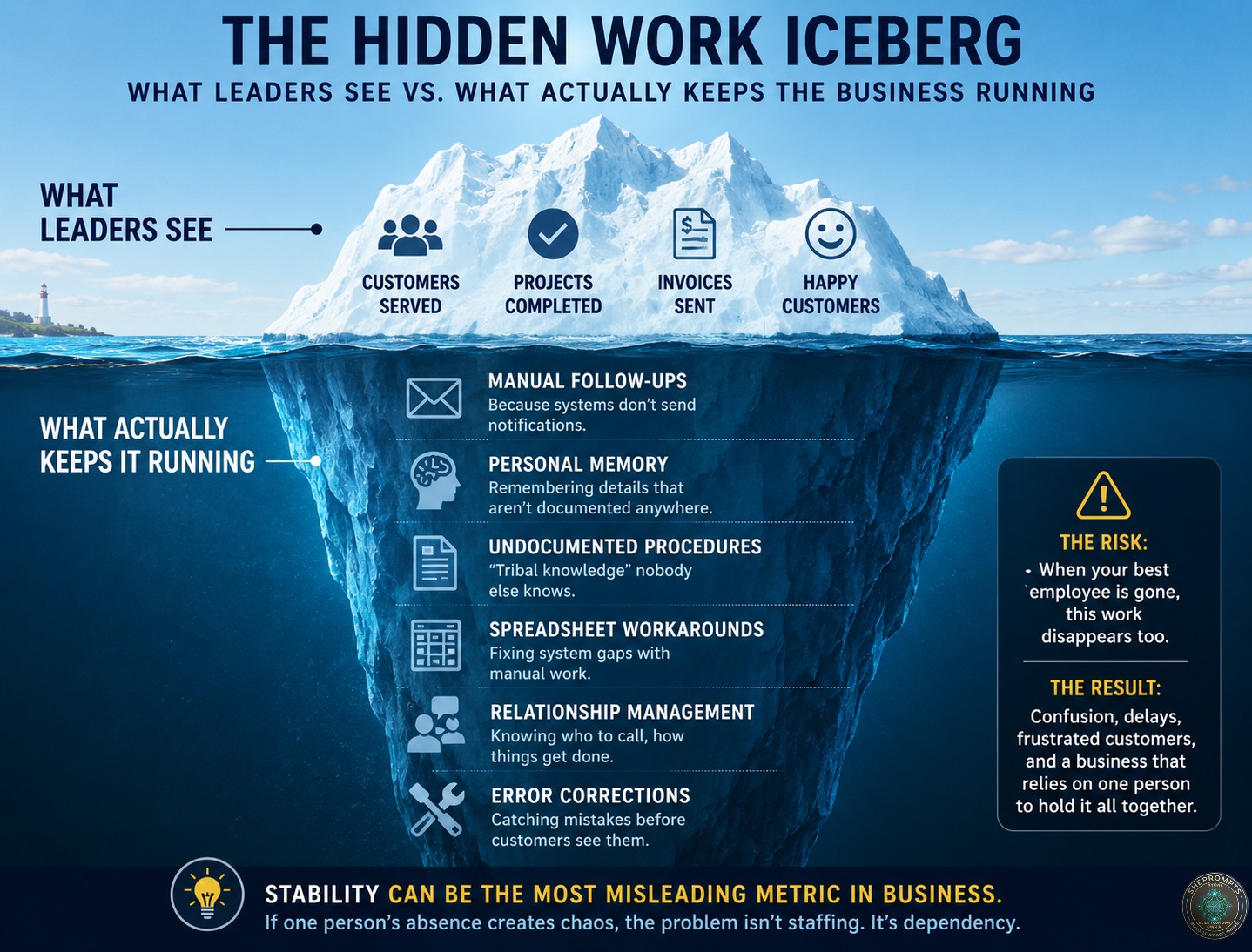
• Remembers information nobody else knows
• Catches mistakes before they become problems
• Follows up manually when systems fail
• Knows exactly who to call to get things done
• Maintains undocumented workarounds that keep operations running
Management sees: "Everything is working."
Reality: "Everything is being rescued."
Your star employee is so good at compensating for the system's flaws that you never realize the system is flawed. They're not making the process better. They're making it invisible.
That’s the opposite of what you want. You want processes that work without heroes. You want systems that don't require savers.
The Invisible Work Nobody Measures
There's a term for this: organizational shadow work. In some sectors, they call it glue work. It's the work nobody officially assigned but everyone relies on. The invisible labor that keeps your business from collapsing.
Remembers customer preferences from three months ago because the CRM doesn't track them.
Manually reminds everyone about deadlines because the project management tool sends no notifications.
Catches errors before customers see them because the quality control system has gaps.
Reconciles data manually in Excel because the accounting software doesn't talk to the billing system.
The most important work in many organizations is work nobody is officially assigned. And here's the problem: You can't optimize what you can't see.
If your best employee is doing shadow work, they're not just doing their job, they're doing someone else's job that nobody realized existed. They're plugging holes in a leaky boat while you're praising them for keeping the ship afloat.
STABILITY CAN BE THE MOST MISLEADING METRIC IN BUSINESS.
Why Leaders Miss It
Leaders see outcomes. Employees experience processes.
The dashboard says:
• Projects completed: 23
• Invoices sent: 87
The dashboard doesn't show:
• 5 hours spent retrieving information from personal memory
• 3 undocumented fixes that prevented customer complaints
• 2 hours of after-hours corrections because nothing was documented
Stability can be the most misleading metric in business. When everything looks stable, you assume everything is working. But if that stability depends on one person's memory, energy, and willingness to work overtime, you don't have a functioning system. You have a ticking time bomb.
Your best employee is burning out. They're not saying anything because they're proud they're keeping things running. They're not asking for help because they don't want to admit they're doing work that shouldn't fall to them or in some cases, what they’re doing is “job security”. And you? You're completely unaware that your entire operation is resting on their shoulders.
The Vacation Audit
Here's how to find these hidden bottlenecks: Take a vacation. Or, if you're the leader, ask your best employee to take one. Vacations don't create bottlenecks. They reveal them.
When someone steps away, ask these questions:
What stopped?
• Which tasks didn't get done at all?
• Which customers went unanswered?
• Which processes just… halted?
What slowed?
• Which tasks took longer than usual?
• Which decisions got delayed?
• Which approvals got stuck?
Who became confused?
• Who asked "where do I find this?"
• Who didn't know what to do next?
• Who had to call the vacationing person for help?
What knowledge disappeared?
• Which files couldn't be found?
• Which relationships weren't maintained?
• Which context wasn't communicated?
Key insight: The answers to these questions aren't about your employee. They're about your system. If one person's absence reveals chaos, that person wasn't the problem. The dependency was the problem.
What Smart Organizations Do Differently
Organizations that scale don't rely on heroes. They rely on systems. What they do:
They don't do this because employees aren't valuable. They do this because employees are too valuable to become single points of failure. Your best employee should be growing, creating, leading—not holding your entire operation together with duct tape and pure willpower.
The Day Your Business Breaks
Here's the truth: The day your best employee leaves isn't the day your business breaks. It's the day you discover where it was already broken. They could quit tomorrow. They could get sick. They could have a family emergency. They could just… decide they're done.
If one vacation can cripple a process, your problem isn't staffing. It's dependency. You've built a business that requires a specific person to function. That's not a business. That's a job with overtime.
Find the shadow work. Map the invisible processes. Document the undocumented. Cross-train the critical tasks.
YOUR BEST EMPLOYEE SHOULDN'T BE YOUR BOTTLENECK. THEY SHOULD BE YOUR MULTIPLIER.
Is your workflow hiding bottlenecks behind your best people?
I help businesses identify time-wasting bottlenecks and build systems that work without heroes. Let's audit your workflow and find the hidden dependencies before they become emergencies.
Sources for further reading:
- Organizational Shadow Work: Definition & Context
https://theanarchistlibrary.org/library/ivan-illich-shadow-work - Workflow Bottleneck Audit & Dependency Analysis Guide
https://www.upwork.com/services/product/consulting-hr-a-workflow-audit-identifying-time-wasting-business-bottlenecks-2062141605725518723