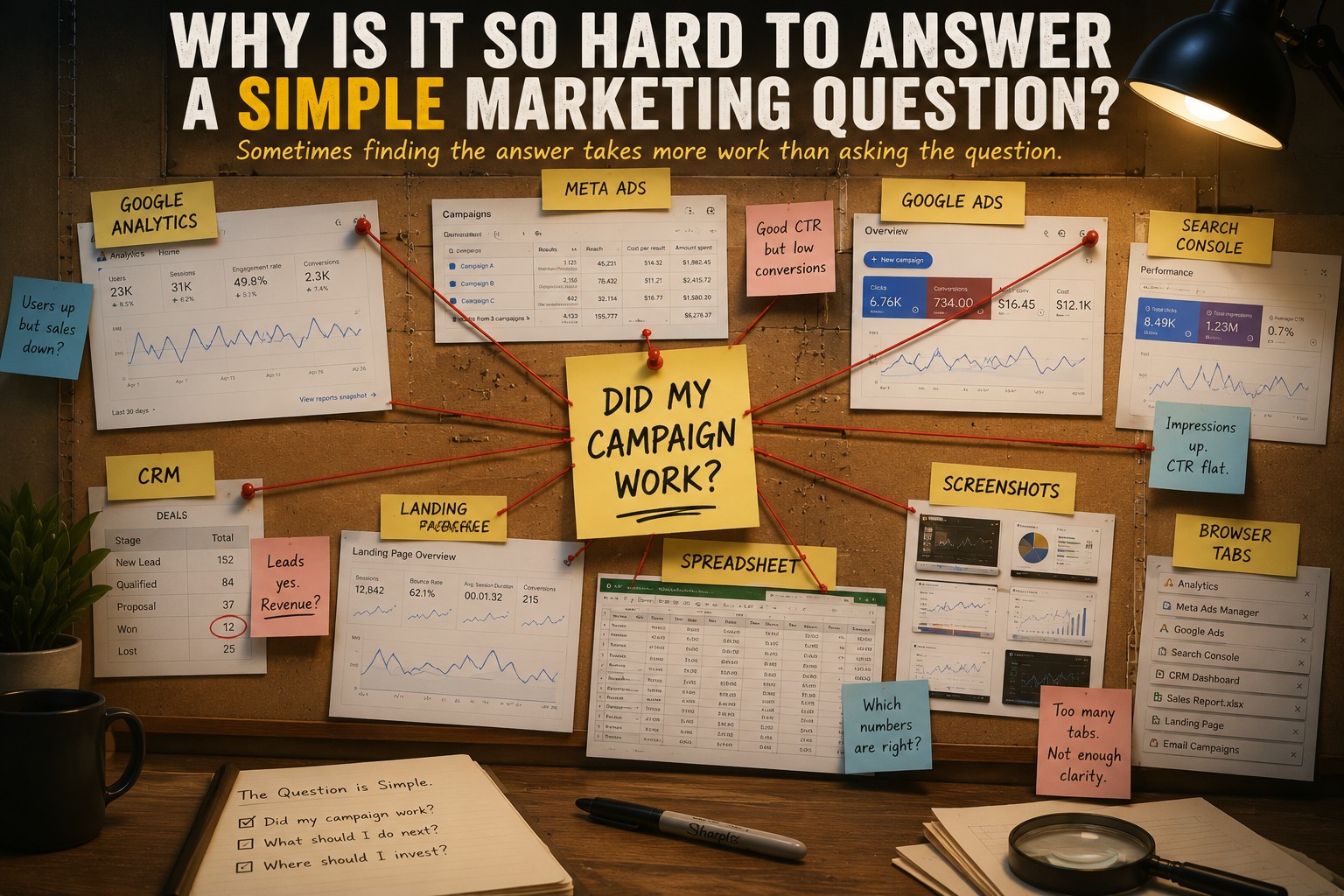
Remember that classic Tootsie Roll commercial from the '80s? The one where the boy finally asks the owl how many licks it takes to get to the center of a Tootsie Roll Pop? When it came to getting my advertising analytics, I found myself wondering something very different: How many reports do I have to download just to know whether my ad campaign actually worked?
I had to switch browsers to download one set of data. Then I had to log into another platform to download two more reports. Then there were the screenshots…
By the time I had gathered everything together, I had almost forgotten the original question. I know I'm not alone.
Many business owners go through this every day. The question itself isn't complicated. Getting enough information to answer it becomes the mission, and that's where the frustration begins. Anyone who's spent time inside Google Analytics, Meta Ads, or similar platforms knows exactly what that feels like. GA4 is a powerful analytics platform, but for many business owners it still feels like a tool designed for analysts rather than decision-makers.
The Question Is Simple. The Answer Isn't.
This all started with Facebook. I was running an ad for one of my demos and wanted to understand whether it was actually working beyond the basic numbers. Clicks and impressions were interesting, but they weren't answering the question I really cared about.
I could see one isolated set of basic dashboard metrics moving in real time.
I couldn't even download the report properly. Chrome kept throwing export errors, forcing an emergency switch to Microsoft Edge.
Then I opened Google Analytics to piece together user sessions, landing pages, countries, and dates so I could correlate what happened after someone clicked the ad. It struck me how many steps I had to take to answer one simple question: Did my campaign actually work?
That's when I started thinking about every other business owner doing exactly the same thing. Whether it's marketing, SEO, e-commerce, or social media, most of us aren't answering questions directly. We're collecting evidence from multiple platforms, matching it together, and trying to build enough context to reach a conclusion—all while wondering whether we've even gathered the complete picture. We don't actually have the answer. We're assembling the evidence needed to find it.
We Mistook More Data for Better Answers
Today we have dashboards, reports, CRMs, advertising platforms, website analytics, social analytics, and enough metrics to fill an executive presentation.
✓ We know where visitors came from.
✓ We know how many pages they viewed.
✓ We know which buttons they clicked.
✓ We know how long they stayed.
Yet many business owners still find themselves asking the same surprisingly simple question: "So...did the campaign actually work?"
The irony is that we aren't suffering from a lack of information. We're drowning in it. Somewhere along the way, we confused collecting more data with understanding it.
The problem isn't that we have too little data. The problem is that our information lives in separate places, each holding one small piece of the story. We spend more time hopping between reports than actually thinking about what the reports mean.
SOMEWHERE ALONG THE WAY, WE CONFUSED COLLECTING MORE DATA WITH UNDERSTANDING IT.
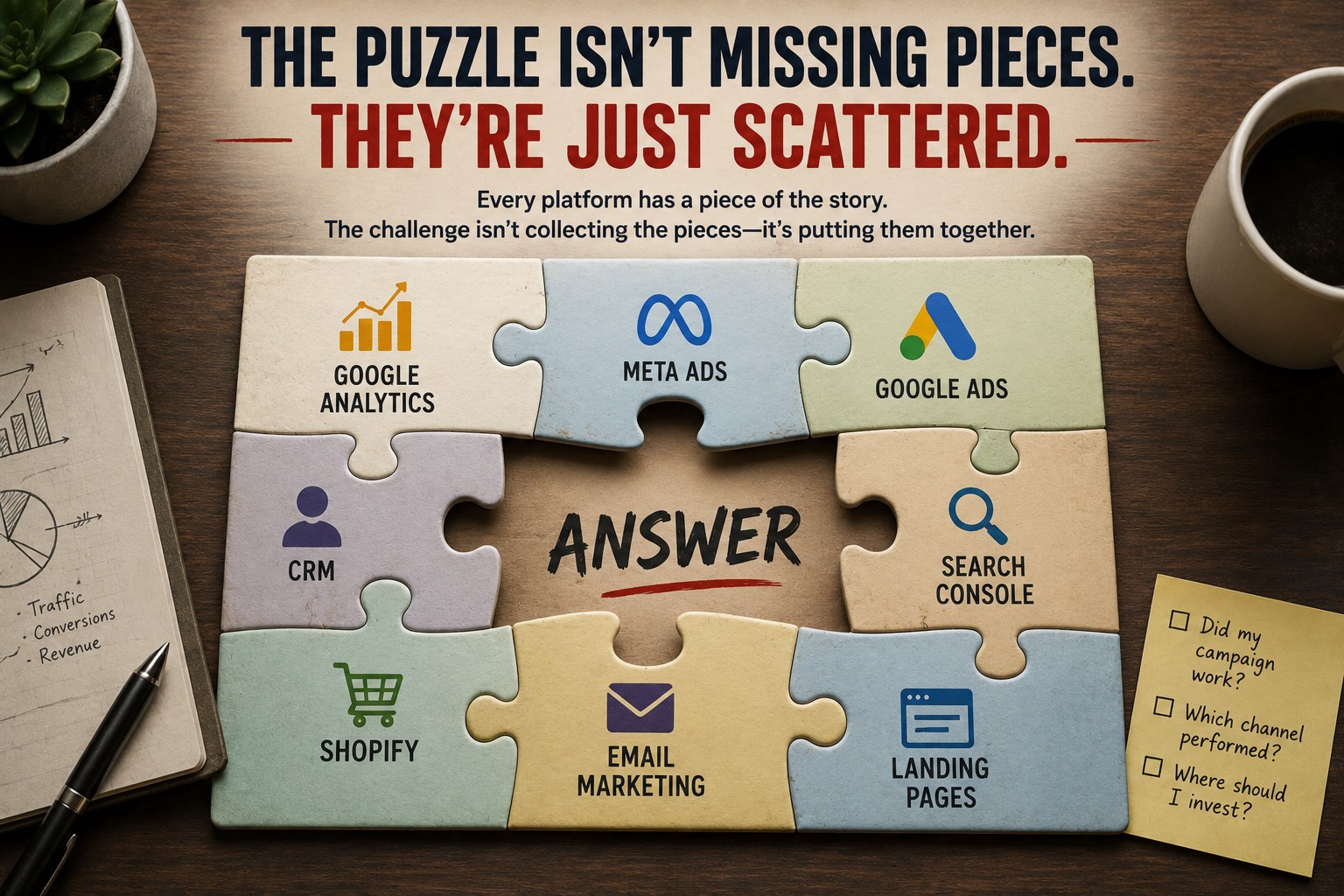
The more I worked through this process, the more I realized the problem wasn't that I lacked marketing data. I had plenty of it. The problem was that answering one simple business question required gathering pieces of information from multiple platforms before I could even begin thinking about the answer. The friction wasn't in collecting data. The friction was in connecting it.
Why GA4 Isn't Really the Problem
It's easy to blame Google Analytics 4. Its interface is different. Finding information often takes longer than people expect, and many users miss the simplicity of Universal Analytics. But GA4 isn't actually the problem.
In many ways, it's doing exactly what it was designed to do. It provides incredibly detailed behavioral data that previous versions couldn't capture. The real issue is that no single platform was ever designed to answer every business question.
Business decisions usually require information from all of them. The challenge isn't collecting the data anymore. It's connecting the pieces into something meaningful.
What We're Really Missing
Most business owners don't wake up wishing they had another dashboard. They wake up wanting answers.
Critical Business Decisions Hidden In Your Reports:
• Which campaign actually generated customers?
• Why did conversions suddenly drop?
• Why are people visiting but not buying?
• Should we increase our advertising budget or fix the landing page first?
Those aren't reporting questions. They're business questions. The reports simply contain clues. No single report tells the whole story. Every report is a witness. Your job is to piece together the testimony.
Unfortunately, most of our tools were designed to collect information, not explain what it means. That's why we spend so much time report-hopping. We're trying to build the story ourselves.
Better Questions. Better Decisions.
Perhaps the biggest lesson from my experience with Meta Ads and Google Analytics isn't really about either platform. It's about how we think.
Instead of asking, "Which report do I need to open?", we should be asking, "What decision am I trying to make?" That small shift changes everything.
Once the question is clear, the relevant data becomes easier to identify. Instead of collecting every available metric, we begin looking for the evidence that actually helps us move forward. Today we have no shortage of marketing data. What we often lack is a clear path from question → evidence → decision.
That's why answering what should be a simple marketing question can feel surprisingly complicated.
MORE DATA DOESN'T AUTOMATICALLY CREATE BETTER DECISIONS. BETTER QUESTIONS DO.
And better systems make those answers easier to find. The future of business intelligence isn't collecting more reports. It isn't building another dashboard. It's reducing the amount of work required to answer the questions that matter most.
If you've ever found yourself jumping between Google Analytics, advertising platforms, spreadsheets, and screenshots just to answer one simple marketing question, I put together a walkthrough showing exactly what that process looked like—and why it made me rethink how we use marketing data. I'd love to hear whether you've experienced the same thing. Watch the walkthrough below.
Stop Report-Hopping. Start Getting Instant Answers.
Answering strategic marketing and operations questions shouldn't require hours of shifting browsers and parsing broken spreadsheet rows. I build secure, lightweight custom AI data agents that sync straight with your underlying database architectures and files, letting you find the exact insight you need in plain English without monthly platform constraints.
Sources for further reading:
- Google Analytics 4 Properties & Advanced Context Architecture
https://support.google.com/analytics/answer/10089681 - Connecting Disparate Advertising Platforms and Marketing Silos
https://www.upwork.com/services/product/development-it-custom-ai-agent-to-chat-with-your-sql-databases-or-csv-data-2060776657835235856