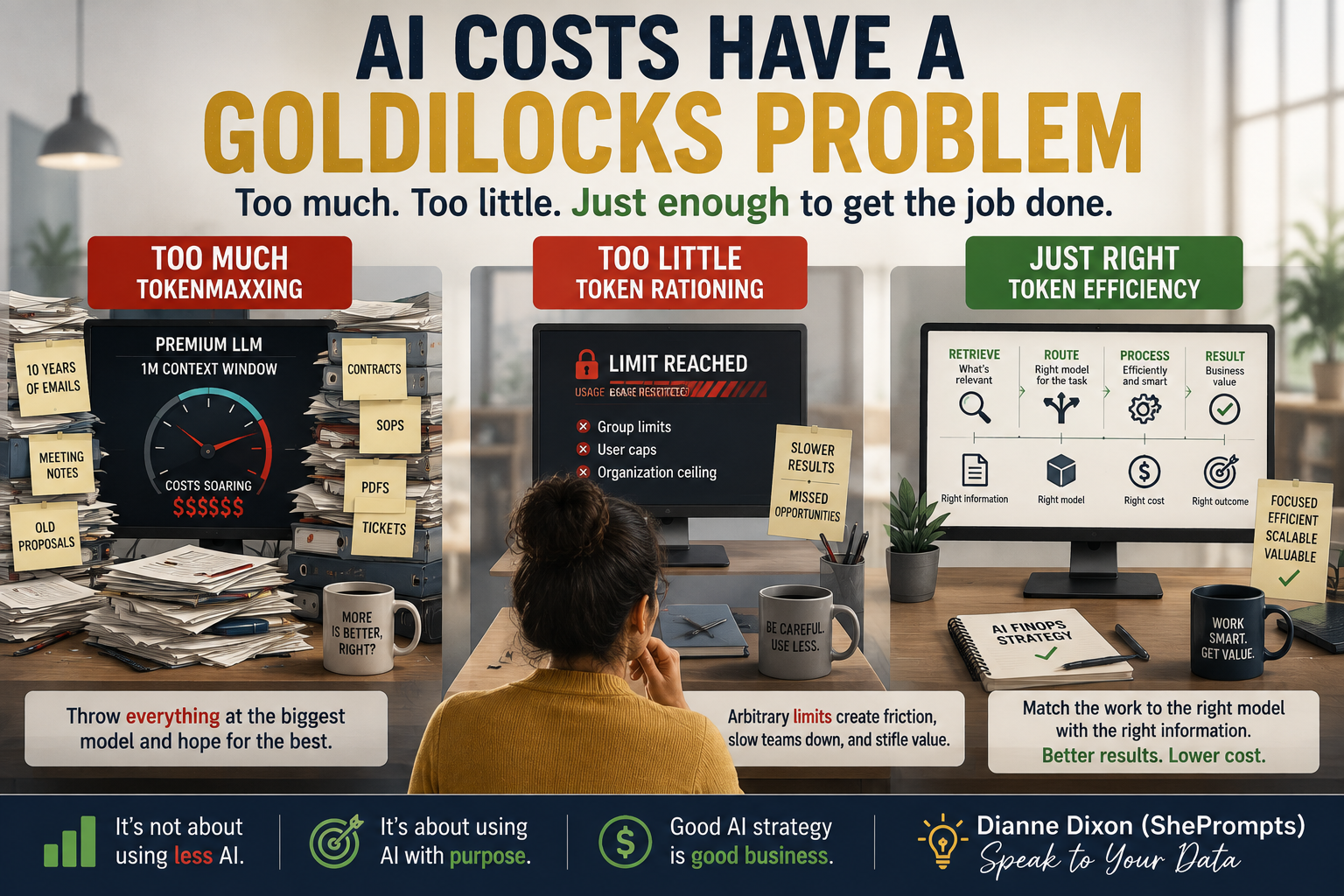
For a while, the message around enterprise AI was remarkably simple:
Use it.
Use it more.
USE IT EVERYWHERE!
In early 2026, that enthusiasm even acquired a name: tokenmaxxing.
The idea was straightforward enough. If AI could make employees dramatically more productive, then organizations should encourage people to use as much of it as possible. Some companies reportedly went as far as treating AI usage itself as a measure of adoption and performance.
There was just one problem.
Using more AI isn't the same thing as creating more value.
And now the bill is becoming harder to ignore.

Anthropic's current Enterprise model is one example of where the market is heading. Enterprise organizations can operate under usage-based arrangements where consumption is separately measured and billed, and Anthropic now provides administrators with detailed visibility into usage and spend by user, model, and product. Organizations can also impose spending limits at the organization, group, and individual levels.
Suddenly, "How much AI are we using?" becomes a financial question.
And that is pushing businesses toward the next phase of AI adoption: token efficiency.
But token efficiency is not the same thing as simply telling employees to use fewer tokens, aka token rationing.
Confusing the two could lead businesses straight into another bad optimization strategy.
From tokenmaxxing to token rationing
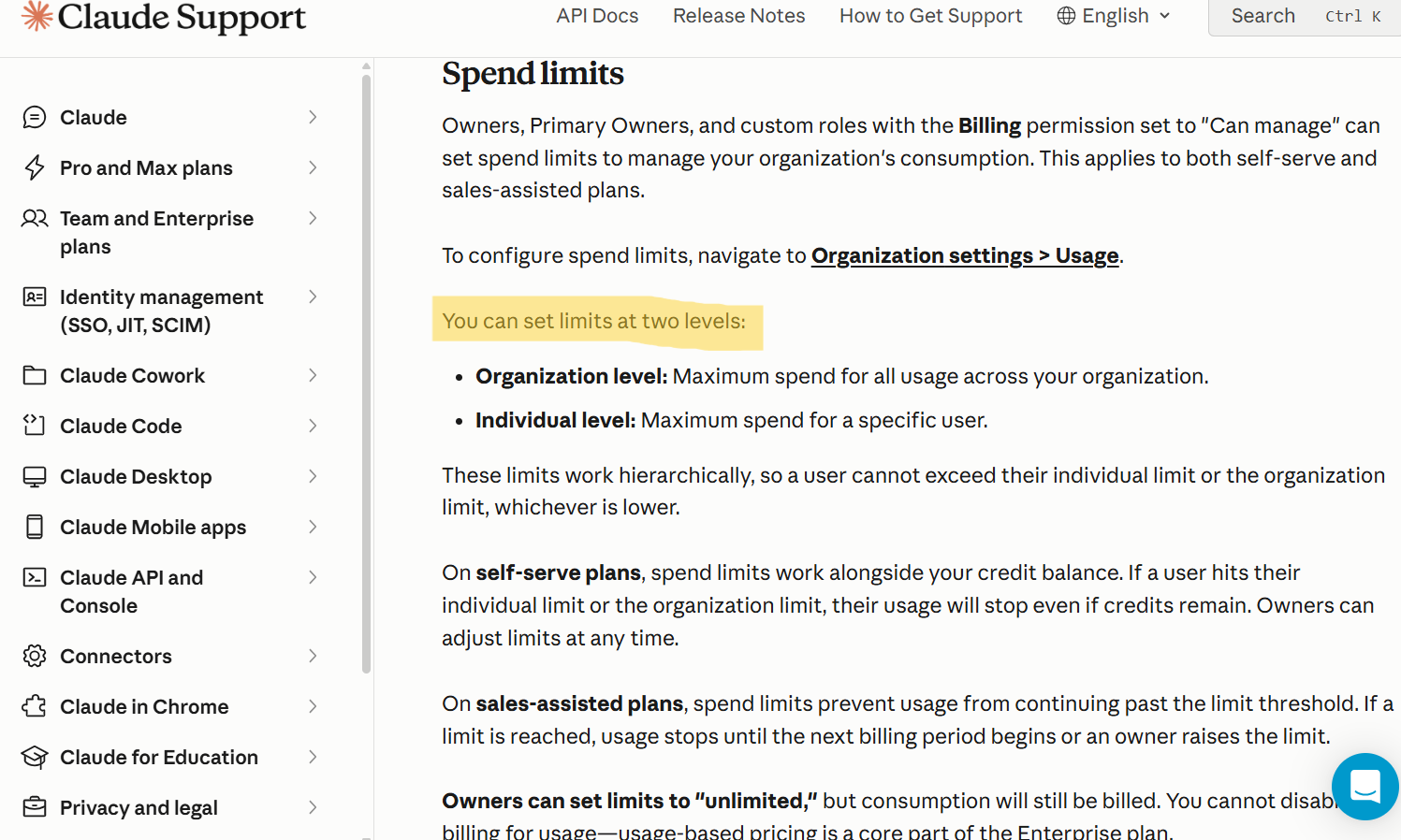
Tokenmaxxing was about maximizing AI usage, while token rationing says, “Don’t use so much.” Enterprise businesses assign admins to set limits, reduce usage, tell employees to be careful, and put caps on the account by organization-wide ceiling, groups or individual users.
But rationing treats consumption as the problem when efficiency asks, “why is this consumption happening in the first place?”
Consider two employees using AI to prepare a customer report. Employee A gives the AI the entire 200-page customer history every time they ask a question. Employee B retrieves the few pieces of information relevant to the question and sends those instead.
Both employees might produce an excellent report, but Employee A may be making the AI process vastly more information than necessary.
The solution isn’t to tell Employee A to "Use fewer tokens" without context, training, or a change in the workflow. That's the distinction businesses need to understand.
The AI industry is starting to make the same realization
The shift isn't hypothetical. Uber's CTO described the company as coming to the end of its "tokenmaxxing" era.
Here’s what the company is doing instead.
Uber has reportedly quadrupled the number of people using frontier AI tools while simultaneously reducing its cost per token. The company attributes some of that improvement to better prompt caching, better default model choices, greater visibility into AI usage, and experimentation with open-weight models.
Spotify has similarly described using lower-cost models for appropriate tasks and giving employees clearer visibility into their AI spending.
Notice what happened there? They didn't just say: "Everybody, use less AI." They made the system more efficient.
That's an important distinction because AI consumption isn't determined by how many times someone presses "send.” It’s affected by what the system has to process to produce the answer.
Modern AI systems can process enormous amounts of information. Claude's paid plans now support context windows of up to one million tokens for some models. In practical terms, that means an AI system can potentially work with hundreds of pages of text—or far more—in a single interaction.
That's powerful, but it's also an invitation to waste. If the system can process everything, people will inevitably start giving it everything. And that's where token efficiency becomes a better solution for this architectural problem.
What is token efficiency, anyway?
Ironically, the easiest way to understand token efficiency is to stop thinking about tokens and think about work.
Suppose you run a small company and build an AI assistant that answers questions about your inventory. A customer asks: "How many Model X units do we have available?"
You don't want the AI to read your entire business database every time someone asks. You want the system to find the relevant inventory record, give the AI that information, and produce the answer.
The AI does less work, you’ve paid for less processing, and the customer still got the answer. That's token efficiency.
It isn't about making the AI "think less." It's about not making it repeatedly process information that isn't necessary for the task.
There are several ways to do this, and many of them sound more complicated than they actually are.
Prompt caching: stop paying to reread the same thing
Imagine you have a 20-page set of company instructions that your AI needs for almost every request. Without caching, the system may repeatedly send those instructions along with each request.
Prompt caching is essentially a way of saying: "We've already given you this information. Keep it available for a while so we don't have to keep sending it from scratch."
Anthropic's API pricing illustrates why this matters. Cached input can be priced substantially below ordinary input, depending on the model and cache configuration. AWS's recent token-efficiency research likewise identifies API-level prompt caching as one of the simplest production-ready ways to reduce inference cost.
For a business, the analogy is simple: Don't keep paying someone to reread the employee handbook before answering every question.
Retrieval: give the AI the relevant pages
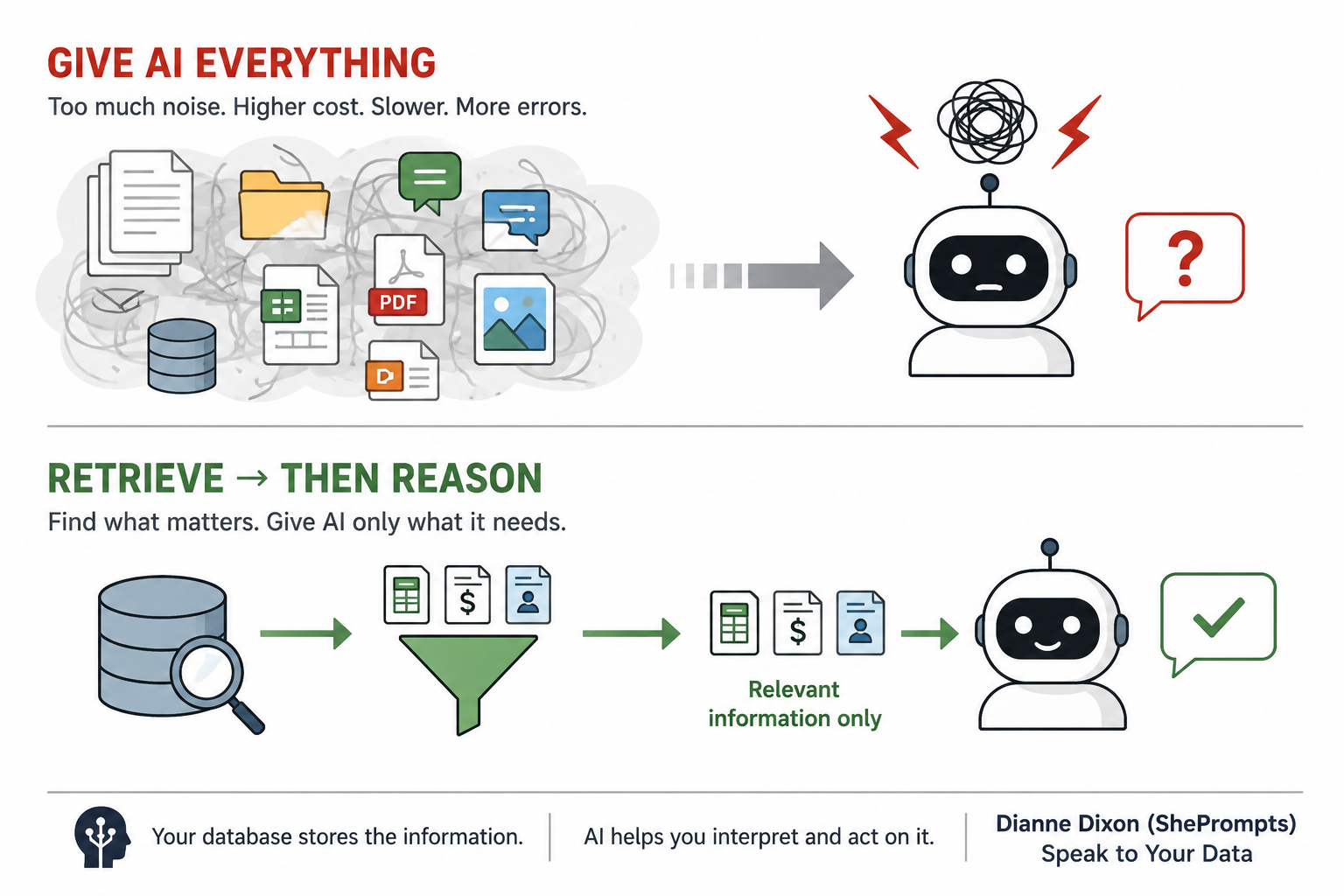
Another common source of waste is simply giving the AI too much information. Suppose you ask: "Which customers haven't paid their invoices?" You probably don't need to hand the AI ten years of customer correspondence.
A well-designed system can search the company's information first, identify the relevant records, and give the AI only what it needs. This is often called retrieval.
In plain English: Find the useful information before asking the AI to reason about it.
That's a huge conceptual shift. The AI doesn't have to be your database. Your database should remain your database. The AI should be the layer that helps you interpret and act on the information.
Model routing: don't use a bazooka to swat a fly
Not every task requires the most powerful, newest model available. If anything, I’d caution businesses to stay a few models older than new. Why?
Simple classification tasks don’t need the same model you use for a complicated financial analysis. In some cases, certain tasks don't need an AI model at all.
Assess the situation and route different tasks to different models. Easy task? Use a cheaper, faster model or code, like Python. Difficult reasoning problem? Use the model that’s great for the task, which may not be the newest, most expensive one, but if it is, make sure it’s worth the expense.
Uber has described this kind of model selection as part of its cost-efficiency strategy, and other large technology companies are exploring similar approaches.
Again, this isn't rationing. You're not telling employees: "You can't use the good model." You're saying: "Let's reserve the expensive capability for the work that actually needs it."
The bigger problem isn't tokens. It's workflow design.
This is where I think the conversation gets especially important for small businesses. A badly designed AI workflow can waste money in ways that aren't obvious to the person using it.
An AI agent might repeatedly search the same files. It might send the same background information with every request. It might use a powerful reasoning model for a simple task. It might generate enormous responses when the business only needs three fields. It might perform the same calculation repeatedly instead of storing the result. It might make multiple AI calls when one carefully designed call would have been sufficient.
None of these problems is solved by telling the employee to "watch their token usage." The system itself needs to change.
That's why I think the next stage of AI optimization will move beyond prompt engineering and into workflow engineering. In that phase, the question becomes: How should the information move through the business so the AI only does the work that actually needs that level of robust intelligence?
That brings us to something much bigger than token efficiency.
Welcome to AI FinOps
FinOps is short for financial operations. Traditionally, it emerged as a discipline for helping organizations understand and manage cloud technology spending.
AI is now creating a similar problem, but with some additional complications. AI cost management went from a minority concern to an almost universal FinOps responsibility in two years: 31% of respondents reported managing AI spend in 2024, compared with expanded adoption today. It’s now the number-one skill area that organizational teams say they need to develop.
That is a remarkable shift.
And importantly, FinOps isn't supposed to mean: "Find the biggest bill and cut it."
The modern conversation is increasingly about technology value. Where did the money go? What generated the spending? Which teams or workflows are responsible? What did the spending produce? Did it create revenue? Did it reduce costs? Did it save employees time? Did it improve customer experience?
The FinOps Foundation explicitly describes the challenge this way: managing AI cost is only the beginning. Organizations also need to connect AI spending to measurable business outcomes.
That's the distinction between AI cost management and AI value management. And I think small businesses should pay attention now rather than wait until they have a $25,000 AI bill.
Imagine the enterprise contract
Let's make the economics concrete without pretending every enterprise contract looks the same. Imagine a large organization with thousands of employees using an AI platform.
Under an older arrangement, the company might have negotiated a substantial enterprise contract where the cost of seats and some level of usage were bundled together. The business could therefore think primarily in terms of: How many employees have access?
Now imagine that contract is renewed under a structure where the organization pays a seat fee for access, while usage is separately measured and charged. The financial equation changes. The organization is no longer simply buying seats. It is buying access plus consumption.
That means the finance department can suddenly discover that two employees with identical seats are generating dramatically different costs. One employee might use AI occasionally for drafting emails. Another might run lengthy coding-agent sessions for hours at a time. A third might have an automated workflow repeatedly sending large amounts of context through an AI system.
The seats look identical on the invoice, but the consumption isn't.
Anthropic's current Enterprise analytics reflect exactly this new reality: administrators can see usage and spend by product, model, and individual, while the system can report metrics such as prompt tokens, completion tokens, request counts, and net spend. For Claude Code, Anthropic even provides measures such as cost per pull request, cost per session, and cost per commit.
That's a very different world from simply counting seats. And it explains why AI FinOps is becoming necessary.
Small businesses have an unusual advantage here
This is where I think the story gets more interesting for small and midsize businesses.
A large company can have layers between the person consuming AI and the person paying for it: employee, department, IT, procurement, finance, enterprise contract, board. The individual employee may never feel the marginal cost of their AI behavior.
A small business doesn't have that luxury. If five people run an AI-powered business and the monthly API bill suddenly triples, somebody notices. Probably the person who owns the credit card.
That's uncomfortable, but it creates an opportunity. Small businesses can build efficiency from the beginning.
A five-person company doesn't necessarily need a six-month AI governance project. It can decide, "This workflow costs too much. Let's redesign it” and:
- Change the model.
- Reduce unnecessary context.
- Add caching.
- Retrieve information before sending it to the AI.
- Store information the AI keeps rediscovering.
- Measure the cost of a workflow against the value that workflow produces.
Smaller organizations have fewer layers between observation and action. That's a genuine potential advantage, but there's an important caveat: Small does not automatically mean efficient.
A five-person business with poorly designed AI agents can waste money just as easily as a multinational corporation. The difference is that the small business may be able to fix the problem on Tuesday instead of creating a committee to discuss it for six months.
Agility becomes an advantage only when someone is paying attention.
The small-business AI efficiency checklist
You don't need to become an AI infrastructure engineer to start. You just need to ask better questions.
-
What does this workflow actually accomplish?
Don't start with: "How many tokens does it use?" Start with: "What business result am I buying?" -
Does the AI need all this information?
If you're sending 100 pages to answer a question about one invoice, something is wrong. -
Are we making the AI rediscover information?
If the answer was established yesterday, can the system store it rather than reconstruct it today? -
Are we using the right model?
Not every task deserves the newest model, which is usually the most expensive. -
Are we repeating the same context?
If the same instructions, documents, or background information are used repeatedly, caching may help. -
What does one successful outcome cost?
This is the metric I would watch. Not merely: "How many tokens did we use?" But: "How much did it cost to successfully process one customer inquiry?", "How much did it cost to qualify one lead?", "How much did it cost to produce one useful report?", "How much did it cost to resolve one support request?"
That is business intelligence. And it is much more useful than staring at a token counter.
The next phase isn't "use less AI"
This is the part I think businesses could easily get wrong. When organizations discover that AI consumption is expensive, the natural response is to impose restrictions.
That's understandable. But therein lies a danger in optimizing the wrong thing.
If an AI workflow saves an employee three hours and costs $2, cutting its usage because the token count looks high may be a terrible business decision.
Meanwhile, an automated process that costs $4 every time it runs but produces almost nothing useful might remain untouched because nobody has connected the spending to the workflow.
The goal isn't fewer tokens. It’s less waste per useful outcome. Those aren't the same thing. And that distinction is going to matter more as AI becomes embedded in everyday business operations.
From tokenmaxxing to AI-native operations
I think we're watching a progression:
First came AI novelty ("Look what this thing can do"), followed by AI adoption ("Everyone needs to use it") and tokenmaxxing ("Use it everywhere").
Now we're reaching AI cost awareness ("Wait. How much are we spending?"), which leads directly to AI FinOps ("Where is the money going, and what are we getting for it?") and eventually token efficiency ("Why does this workflow require so much computation in the first place?").
That final question leads somewhere much more interesting. It leads to redesigning the business around better information flow.
That's where I think the opportunity is for small businesses. They don't have to outspend large enterprises on AI. They may not even be able to. But they can potentially outmaneuver them, by building smaller, cleaner workflows.
They can measure outcomes closer to the point of use; identify waste faster; and design for efficiency before layers of legacy systems and organizational habits make change expensive.
Tokenmaxxing was never really the destination. It was part of the new shiny use case experimentation phase.
Now we're entering the less glamorous phase of AI adoption: measurement, accounting, architecture, governance, optimization, and ROI. In other words: AI is becoming an operating expense. And businesses are finally having to learn how to operate it.
The companies that win this next phase won't necessarily be the ones that use the most AI. They may be the ones that figure out how to get the most useful work out of every dollar they spend on it.
That's not token rationing. It's token efficiency. And it may become one of the defining disciplines of the next phase of AI adoption.
Sources & Further Reading
- Anthropic: Enterprise plan and usage controls documentation
- The Register: Anthropic squeezes enterprises by ejecting bundled tokens from seat deal
- Business Insider: Uber's CTO says the company is coming to the end of its tokenmaxxing era
- FinOps Foundation: State of FinOps 2026 & Connecting AI Spending to Measurable Business Outcomes
- AWS Builder Center: The Token Efficiency Playbook