
You've bought ChatGPT Team.
You've bought Claude.
You've experimented with AI scheduling tools and watched countless demonstrations showing how artificial intelligence can transform the way businesses operate.
Maybe you've even dipped your toes into AI-assisted coding.
So why isn't your business moving faster?
Here's the uncomfortable reality: buying AI tools and transforming a business are not the same thing.
For small and medium-sized businesses, this distinction matters more than ever. Unlike large enterprises, most MSMEs don't have the luxury of burning through massive budgets on experimental projects, endless proofs of concept, or months of trial and error. Every investment must eventually justify itself through increased efficiency, improved customer outcomes, or measurable revenue impact.
Yet many business owners are discovering that despite investing in AI tools, the promised productivity gains remain frustratingly out of reach.
According to Kyndryl's 2026 People Readiness Report, 57% of organizations have embedded AI into their core business processes. However, only 32% achieved even one of their primary AI objectives, and just 11% achieved both.
Think about that for a second.
Organizations are adopting AI at scale, yet the vast majority are struggling to achieve the outcomes they originally set out to accomplish.
The question isn't whether AI works.
The question is why so many businesses fail to convert AI adoption into operational results.
The AI Adoption Illusion
For the past two years, the AI conversation has largely revolved around tools.
Which model is better?
Which platform is faster?
Which AI assistant offers the most features?
The marketed assumption behind these discussions is simple: Buy the right tool and better outcomes will follow.
Unfortunately, business, like life, doesn't work that way.
What it often does is accelerate existing good, bad, and ugly processes. If you remember GIGO, you’ll know that a poorly designed workflow can become a faster poorly designed workflow. An inconsistent review process can become an inconsistent review process operating at twice the speed.
While the technology changes, the underlying business habits remain the same.
Software Is Not Strategy
One of the most common mistakes businesses make is treating software purchases as strategic decisions.
Software is an enabler. Strategy is a plan. The two are not interchangeable.
Many business owners approach AI with a simple expectation:
Buy tool → Save time.
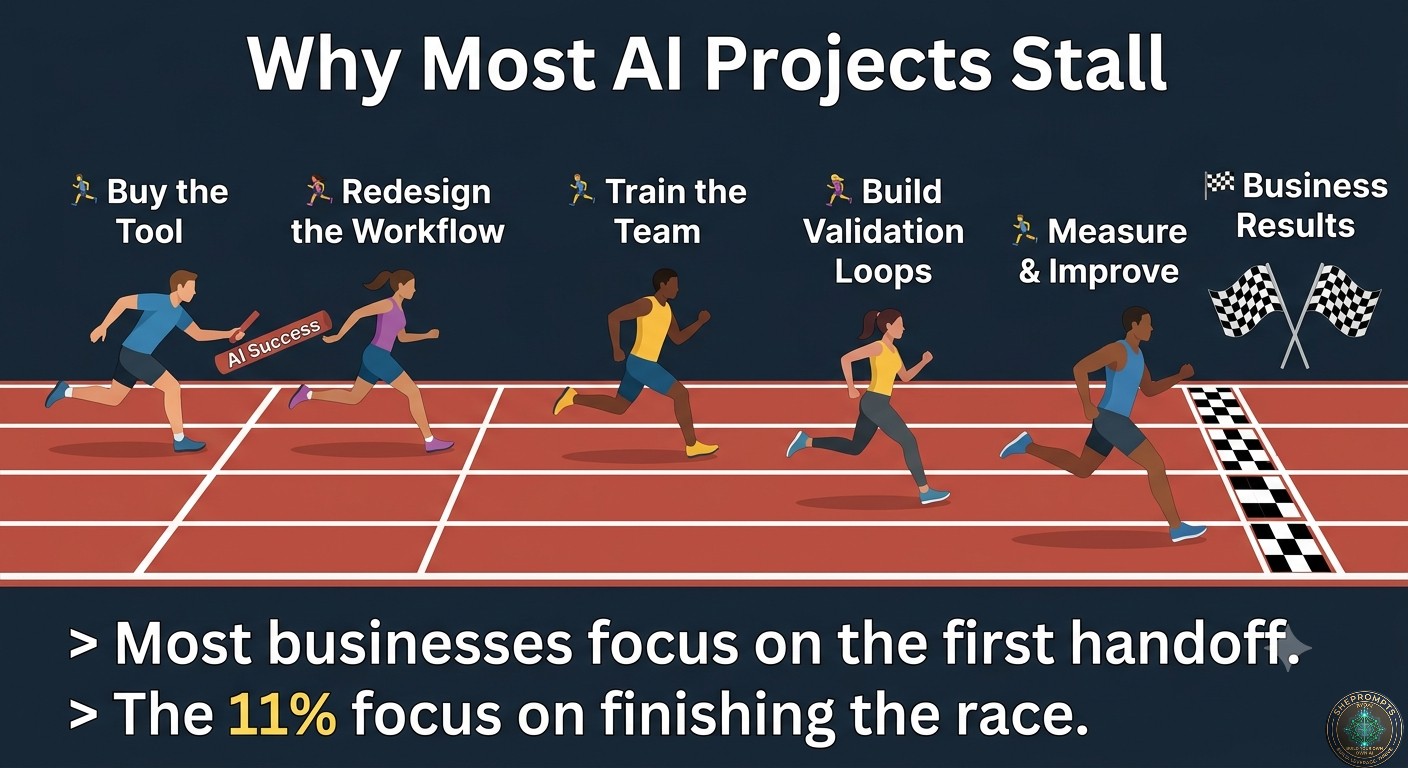
Notice how purchasing the software is only the first step and is the easiest step. The difficult work begins after the subscription is activated. This is where many AI initiatives quietly stall.
The tool arrives. The workflows remain unchanged. The team receives little guidance. The expected gains never materialize.
The Missing Layer: Operational Adoption
The Kyndryl report points to workforce readiness as one of the primary barriers preventing organizations from achieving their AI objectives.
For small businesses, workforce readiness doesn't necessarily mean sending employees through expensive certification programs. It means answering practical questions, some of which need to be answered before buying a tool access:
- What tasks should AI handle?
- What tasks should remain human-led?
- What outputs require review?
- Who is responsible for validation?
- What does success actually look like?
Many organizations skip these conversations entirely. Instead, they provide access to AI tools and hope employees figure things out as they go. The result is predictable: different people use the tools differently, outputs become inconsistent, and best practices never emerge.
The organization gains access to AI without developing a system for using it effectively. This is not an AI problem. It's an operational problem.
The New Bottleneck Nobody Talks About
Ironically, AI often succeeds at the very thing it was designed to do: generating output. The problem is what happens next.
A proposal that once took an hour now takes five minutes. An email campaign that required a full afternoon can be drafted before lunch. Lead research that consumed days can be completed in a fraction of the time.
At first glance, this sounds like a massive productivity win. But there is a catch. Someone still needs to verify the results, confirm accuracy, review client-facing communications, and make the final decision.
In many small businesses, the new bottleneck becomes the owner, manager, or virtual assistant tasked with validating an ever-growing volume of AI-generated work. The faster the front end becomes, the greater the pressure on the review process. This creates a new operational challenge that many businesses never anticipated.
Seeing the Bottlenecks Before They Become Problems
Many AI implementation failures aren't caused by the technology itself. They're caused by operational issues that organizations don't recognize until after deployment: workflow friction, validation delays, disconnected information, undocumented processes, and data inconsistencies.
These problems often remain hidden until they begin affecting performance, customer experience, or decision-making. One of the recurring themes across AI adoption stories is that businesses frequently focus on the tool while overlooking the systems surrounding it.
That's one of the reasons I've been developing Marketing Intelligence. The goal is simple: help businesses identify patterns, workflow friction, information gaps, and operational bottlenecks before they become expensive problems.
What the 11% Understand
The organizations achieving meaningful results appear to understand something others do not: AI is not a software project. It is an operational change initiative.
Successful adoption requires more than access to technology. It requires:
- Clearly defined workflows
- Consistent usage standards
- Human validation procedures
- Team training
- Measurable business objectives
Notice that none of these are product features. They are management disciplines. Organizations that focus exclusively on tools often struggle while those that focus on systems tend to make progress.
A Better Starting Point for MSMEs
Many micro, small, and medium enterprise business owners begin their AI journey by asking: "What tool should I buy?"
A more useful question might be: "What process is costing us the most time, money, or frustration?"
Start there. Identify a workflow that creates delays, rework, administrative burden, or customer friction. Then determine whether AI can help improve that workflow. This approach shifts the conversation from technology acquisition to operational improvement. And that's where meaningful results usually begin.
The Real Lesson Behind the 11%
The lesson from the Kyndryl report is not that AI doesn't work. It clearly does. The lesson is that technology adoption and business transformation are not the same thing.
Most organizations have already purchased the software. Many have already deployed it. Far fewer have done the difficult work of changing how people, processes, and workflows operate around it.
That's why the 11% statistic matters. It reminds us that the biggest barrier to AI success isn't necessarily the technology itself. It's the operational readiness of the organization using it.
The question isn't whether your business has access to AI. The question is whether your business is prepared to use it effectively.