In 2024, Google's AI made headlines after confidently claiming that microscopic bees helped power computers. The explanation sounded authoritative. It was also completely wrong.
Stories like this have become the poster child for AI "hallucinations," defined as instances where an AI system presents false information with remarkable confidence. If you check out certain Reddit threads, they make for entertaining headlines and often reinforce the belief that AI simply can't be trusted.
But for most small and medium-sized businesses, hallucinations aren't the biggest risk.
The bigger risk is that AI faithfully reflects the gaps, inconsistencies, and undocumented knowledge that already exist inside the business.
That's a much harder problem to solve because it isn't an AI problem. It's an operational one.
Your Business Runs on Three Layers of Knowledge
When business owners hear the phrase "data quality," they often think about spreadsheets, customer records, invoices, or inventory counts. Those things certainly matter, but they represent only one layer of how a business operates.
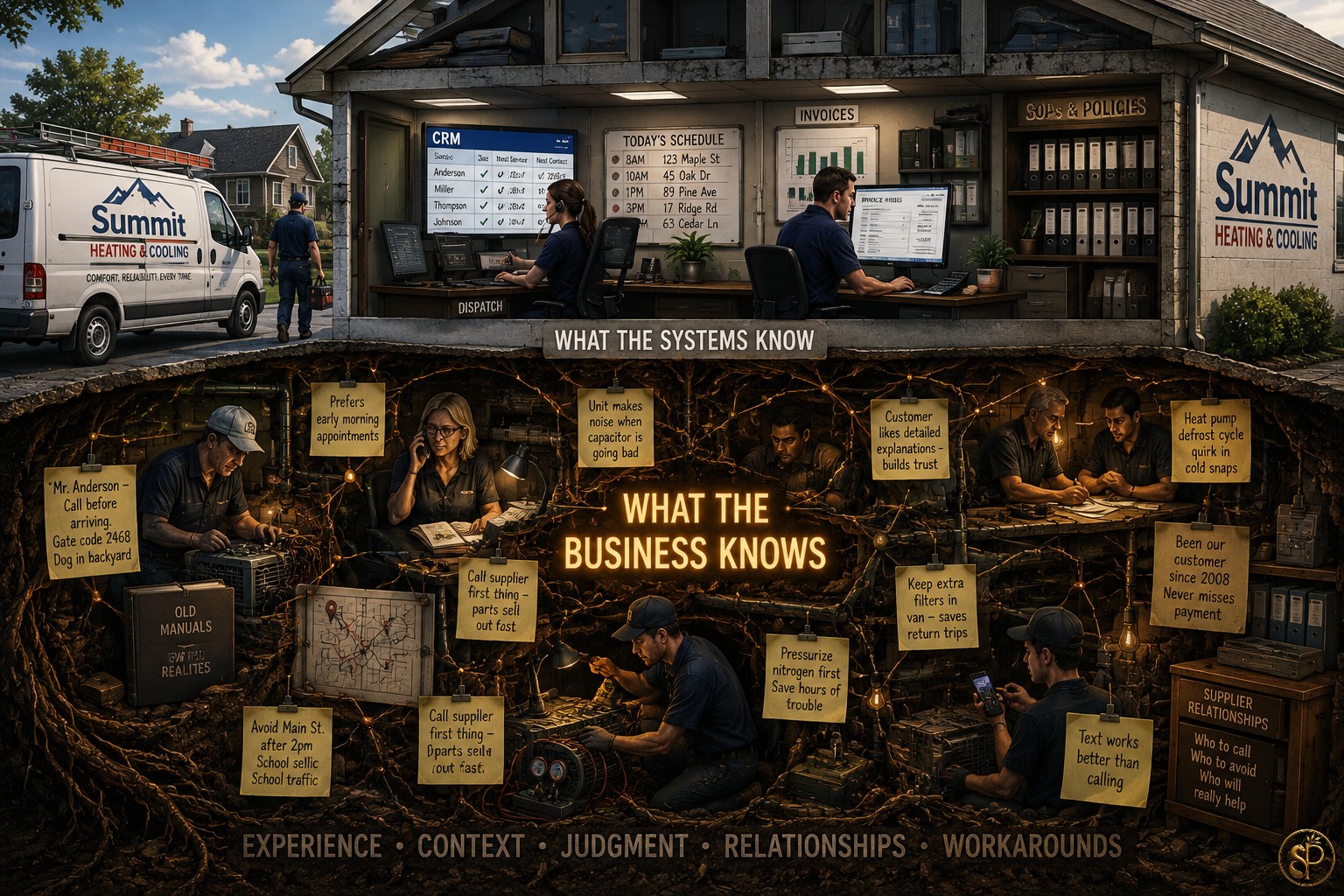
My theory is that every business relies on three distinct layers of knowledge.
The first is data. These are the measurable facts: customer names, invoices, purchase orders, inventory levels, appointment dates, sales figures, and transaction histories. Data tells you what happened, and it’s measurable and therefore controllable.
The second is information. This isn’t the same as data. Information is the documented knowledge that explains how work is supposed to happen: standard operating procedures (SOPs), employee handbooks, service manuals, pricing guides, CRM notes, training documents, and internal policies. Information provides structure and consistency.
Then there's a third layer that is often the most valuable and the least visible.
It's the accumulated experience that lives inside people's heads.
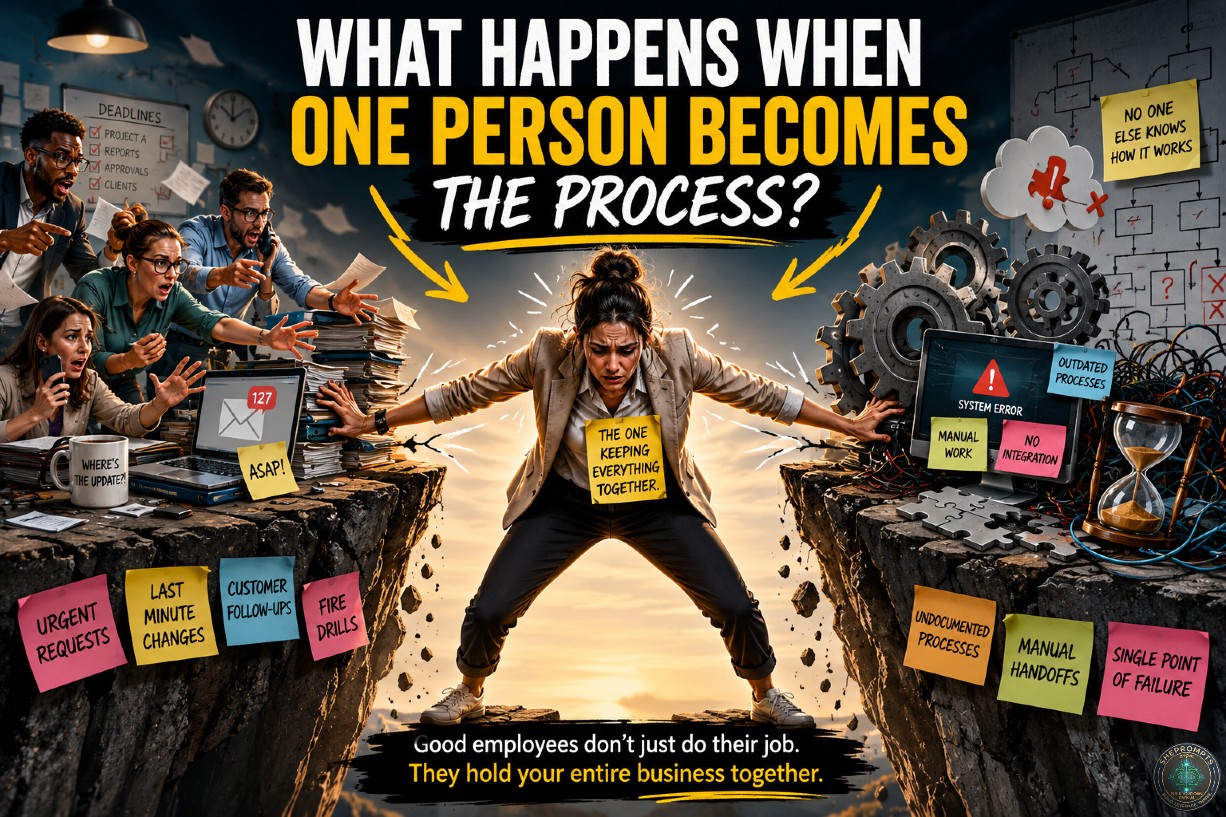
The office manager who knows which customer always calls back with one more question.
The dispatcher who instinctively schedules two nearby service calls together because traffic is unpredictable after lunch.
The senior technician who recognizes a recurring equipment issue before anyone else notices it.
The accountant who remembers why a long-standing client prefers invoices prepared a certain way.
Management researchers often refer to this as organizational memory: the practical knowledge, judgment, context, and experience a business accumulates over years but rarely documents completely.
Ironically, it's often this invisible layer that keeps the business running smoothly.
The Business Behind the Business
Every company has a public-facing business that customers see.
Customers see technicians arriving on time, invoices being sent, estimates being prepared, and questions being answered.
Behind that visible business is another one entirely.
It's made up of thousands of small decisions, workarounds, exceptions, relationships, and pieces of context that never appear in a database. Employees quietly compensate for outdated documentation, incomplete customer records, conflicting procedures, and unwritten expectations because they know how the business really works.
Over time, this becomes normal.
Experienced employees bridge the gaps without anyone realizing those gaps exist.
That's one reason certain employees become indispensable. They aren't simply doing their jobs. They're carrying a significant portion of the company's operational knowledge.
When they leave, businesses often say they "lost a great employee."
In reality, they've lost years of accumulated organizational memory.
AI Amplifies Confusion
Before AI became part of everyday work, people naturally compensated for incomplete information.
If a procedure didn't make sense, they asked a coworker.
If two documents conflicted, they relied on experience.
If a customer's history was incomplete, someone remembered the missing details.
People are remarkably good at filling in the blanks.
AI isn't.
An AI assistant doesn't know that one pricing guide is outdated unless someone has removed it.
It doesn't know that the CRM contains duplicate customer records.
It doesn't know that employees stopped following a documented procedure three years ago because a better process emerged. It can only work with the knowledge your business captured.
That's why AI often appears inconsistent. It's not always inventing problems. Sometimes it's faithfully reflecting the inconsistencies that already exist throughout an organization.
In that sense, AI is a force multiplier.
If your knowledge is organized, accessible, and current, AI can make your team faster and more consistent. But if it's fragmented, outdated, or contradictory, AI can spread those problems just as efficiently.
Information Quality Is Becoming an Operational Risk
For years, poor documentation mostly resulted in frustration that workers tolerated. Those inefficiencies were real, but they were often absorbed by the people closest to the work.
AI changes the economics of poor information.
When businesses begin relying on AI to answer questions, draft responses, summarize documents, or assist employees, the quality of the output depends directly on the quality of the knowledge behind it.
Suddenly, information quality isn't just an administrative concern, it's also an operational one.
Poor knowledge management can lead to inconsistent customer service, incorrect pricing, slower onboarding, duplicated effort, avoidable mistakes, and reduced confidence in AI systems that may simply be exposing existing weaknesses.
You Don't Need to Document Everything
Reading this, it's easy to conclude that every process, exception, and lesson learned should be documented immediately. That's neither practical nor necessary.
A better starting point is identifying the knowledge your business depends on but cannot easily explain.
To do that, ask yourself a few questions.
If your most experienced employee resigned tomorrow, what knowledge would disappear with them?
Which decisions rely on "Just ask Sarah" or "Mike knows how to do that"?
Which customer promises exist only because someone remembers them?
Which workarounds have quietly become the real process, even though they're documented nowhere?
Those answers reveal where your business is relying on organizational memory instead of organizational knowledge.
Before You Scale AI, Scale Understanding
Many organizations are asking whether they're ready for AI.
A better question might be whether they're ready to teach AI how their business actually works.
Technology can neither preserve knowledge that has never been captured nor can it resolve contradictions that no one has addressed.
And it can't replace years of accumulated judgment that exist only in the minds of experienced employees.
The businesses that benefit most from AI won't necessarily have access to the newest models or the largest budgets.
They'll be the businesses that understand their own operations well enough to turn experience into shared knowledge, documentation into better decisions, and information into lasting organizational intelligence.
Because in the age of AI, "garbage in, hallucination out" isn't just a warning about technology.
It's a reminder that every business eventually has to confront what it truly knows and what it has only been remembering.