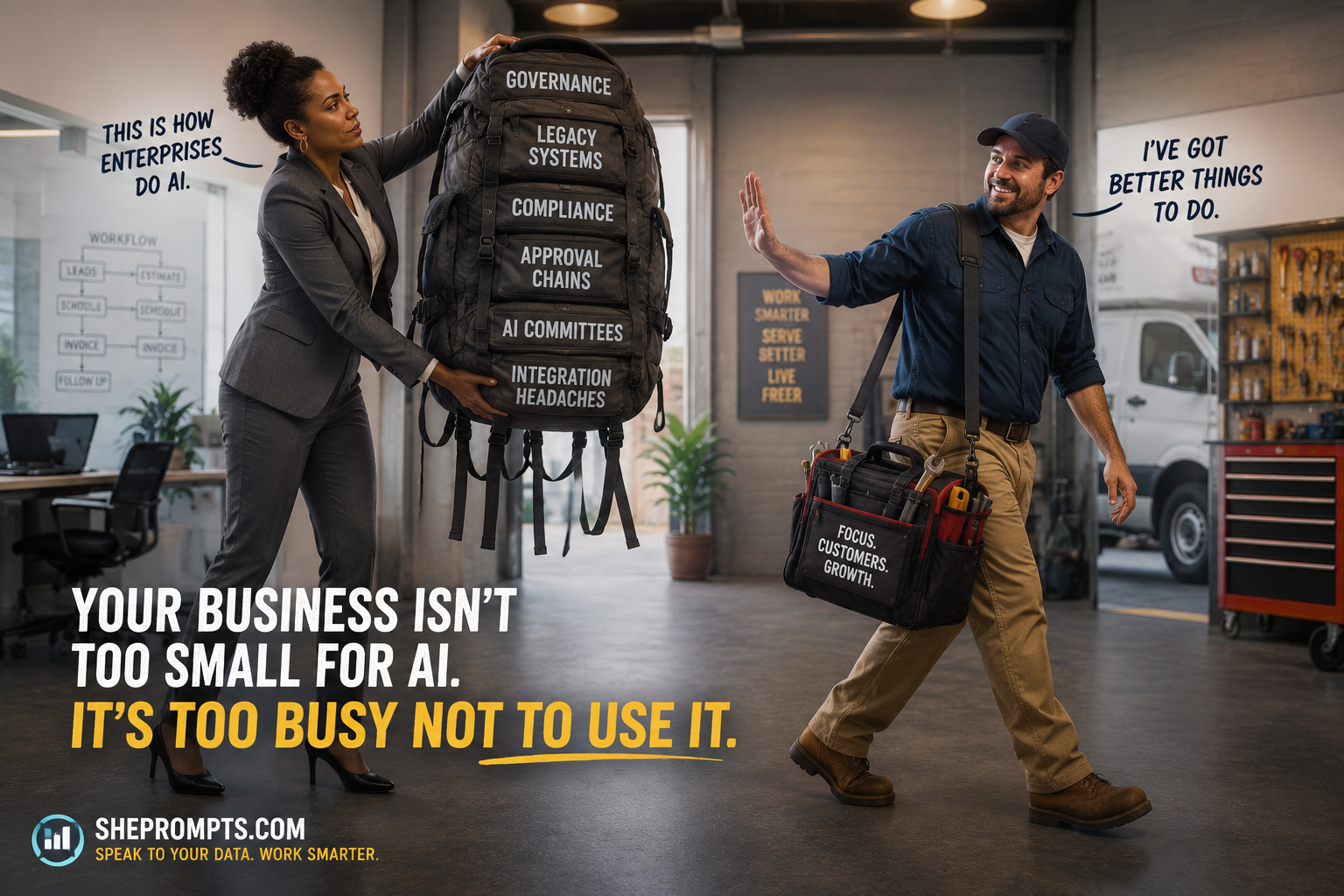
If you spend enough time reading about artificial intelligence, you'd think every company is racing to build custom AI models, hire machine learning engineers, and invest millions in digital transformation.
The conversation is dominated by Fortune 500 companies. Every week there seems to be another headline about billion-dollar AI investments, another model announcement, another benchmark, or another prediction that everything is about to change.
If you're running a plumbing company, an accounting practice, a marketing agency, or a business with ten or twenty employees, it can feel like none of this applies to you.
In many ways, it doesn't.
Your AI strategy shouldn't look anything like theirs.
Small businesses don't need AI transformation.
They need AI relief.
The Wrong Benchmark
One of the biggest mistakes small business owners can make is measuring themselves against enterprise AI stories.
It's understandable why. Enterprise AI dominates the conversation. But large organizations operate in an entirely different world.
They have legacy systems that have evolved over decades. They have multiple departments with competing priorities, compliance requirements, governance processes, approval chains, and thousands of employees working across disconnected systems.
Introducing AI into an organization like that isn't simply a technology project.
It's an organizational project.
That's why so much of today's research focuses on productivity gains, workforce composition, organizational adoption, and enterprise transformation.
Those are important questions.
They're just not the questions keeping most small business owners awake at night.
You're probably asking questions like:
How do I get estimates out faster?
How do I stop answering the same customer questions over and over?
How do I spend less time buried in paperwork?
How do I make better decisions without spending my evenings digging through spreadsheets?
Those are AI questions too.
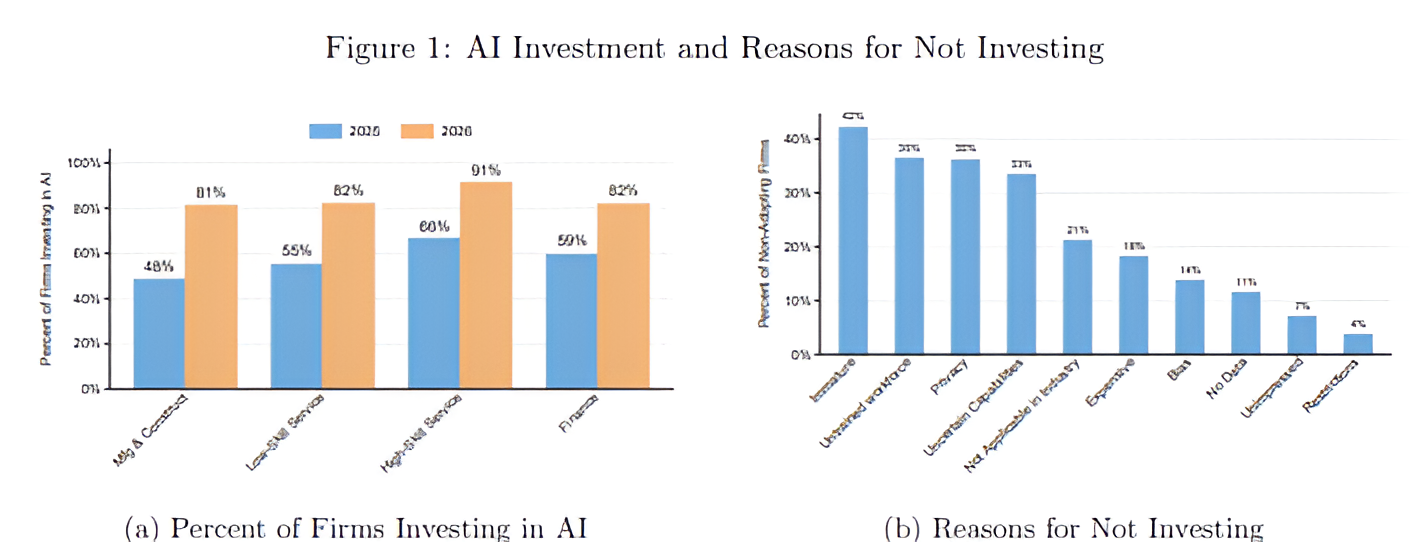
The difference between enterprise concerns and small business realities becomes even clearer when you look at why organizations hesitate to invest in AI.
What Large Companies Are Actually Trying to Achieve
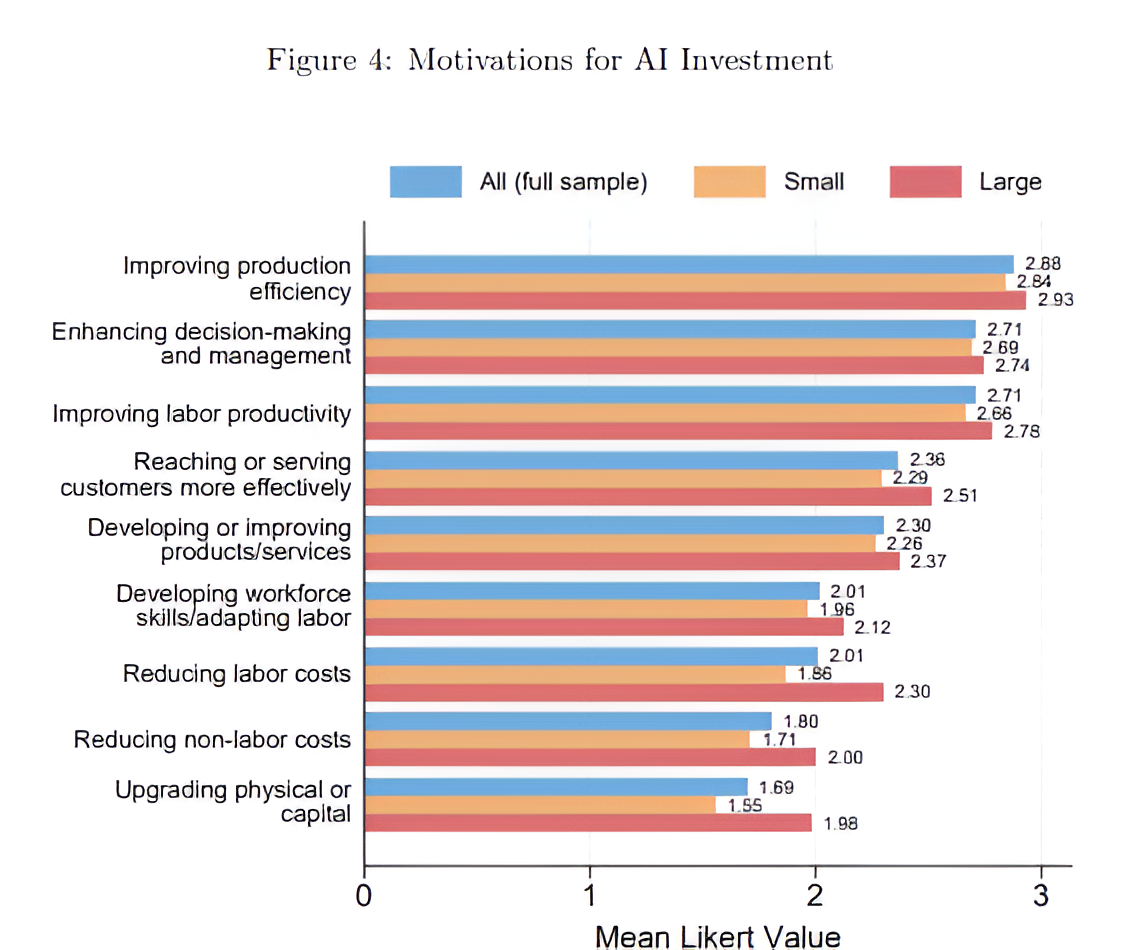
A recent survey of nearly 750 corporate executives revealed something I found surprisingly encouraging.
The most important motivations for investing in AI weren't primarily reducing labor costs or replacing employees.
Instead, executives consistently ranked improving production efficiency, enhancing decision-making, improving labor productivity, and serving customers more effectively as their biggest motivations for adopting AI. Cost reduction ranked noticeably lower.
The survey paints a very different picture from the headlines. Organizations are investing in AI primarily to improve how work gets done—not simply to eliminate jobs.
That matters because it challenges one of the biggest myths surrounding AI.
The headlines often focus on automation replacing people.
The executives actually writing the checks are focused on making their organizations operate better.
That's a very different conversation, and it's one that small businesses should pay attention to.
Why?
Because those goals aren't unique to billion-dollar companies.
Every business wants to serve customers more effectively.
Every business wants to make better decisions.
Every business wants employees spending more time on valuable work instead of repetitive tasks.
Your Biggest Advantage Isn't Your Size
Ironically, one of the biggest advantages small businesses have is that they don't have enterprise complexity.
If a Fortune 500 company wants to redesign a workflow, it may involve multiple departments, legal review, security teams, compliance officers, IT architecture, procurement, and months of meetings.
A small business owner can decide during lunch.
That agility is an enormous competitive advantage.
You don't need an AI steering committee to automate appointment reminders.
You don't need six months of governance meetings to create a better proposal template.
You don't need a multimillion-dollar transformation program to summarize customer emails, organize documents, or draft first-pass reports.
Sometimes the biggest improvements come from solving the smallest frustrations.
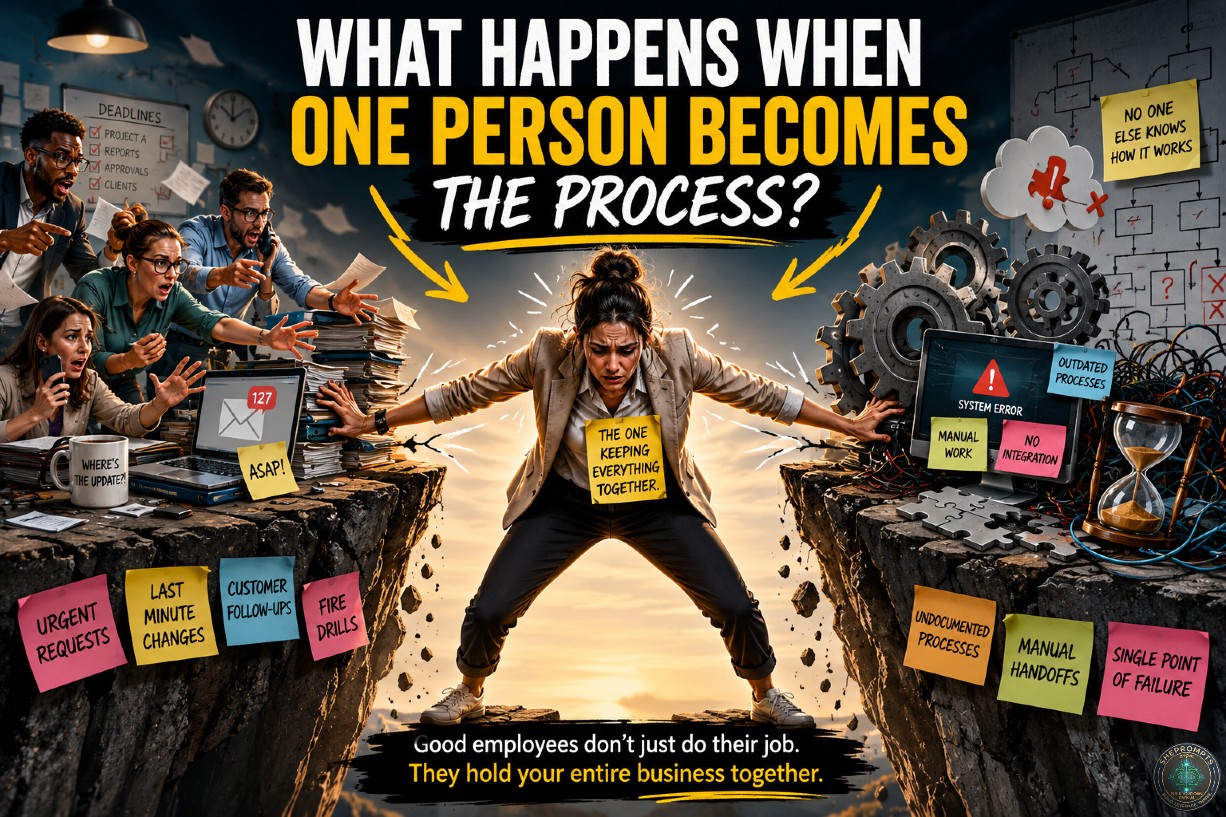
Stop Looking for Transformation. Start Looking for Friction.
Instead of asking,
"How can AI transform my business?"
try asking:
Where does my business waste time every single day?
Where do employees repeatedly copy information from one system to another?
Which emails sound almost identical every week?
Which reports take hours even though they follow the same format every month?
Which customer questions always require the same explanation?
Which decisions require hunting through spreadsheets before anyone feels confident enough to act?
Those aren't glamorous problems.
They're operational problems, and they represent some of the best opportunities for AI.
Technology doesn't have to revolutionize your business to create value.
Thirty minutes reclaimed each day may not sound revolutionary, but over the course of a year it becomes hundreds of hours that can be spent serving customers, following up on leads, training employees, or improving the business instead of simply maintaining it.
Relief Before Revolution
Another finding from the executive survey stood out.
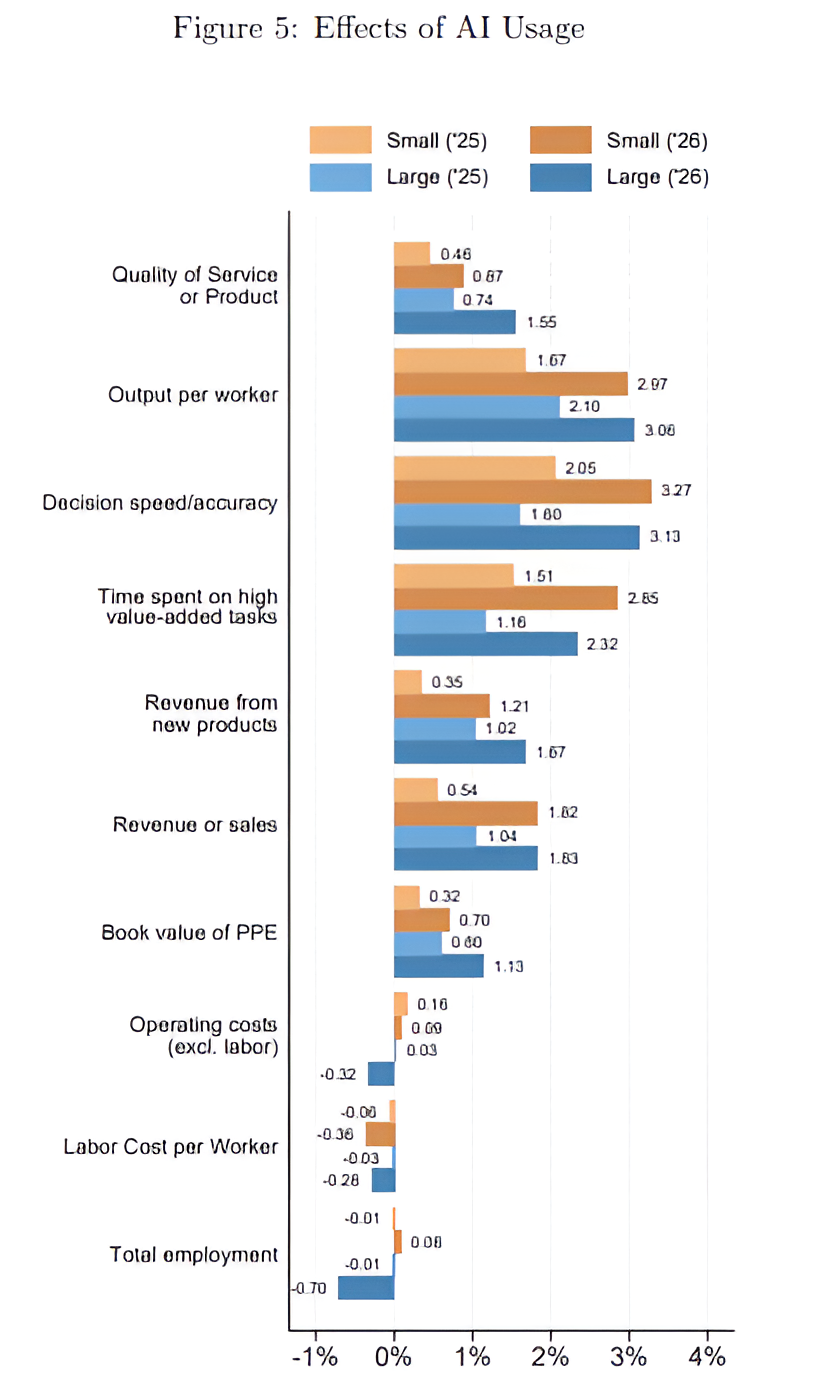
The most commonly reported benefits of AI weren't massive reductions in headcount or dramatic cost savings.
Instead, organizations reported improvements in output per worker, decision speed, quality of work, and the ability to spend more time on higher-value activities.
Those priorities closely mirror what most small businesses are trying to achieve every day.
Imagine reclaiming two hours every week because meeting notes are summarized automatically.
Imagine proposals being drafted before you've finished your coffee.
Imagine customer inquiries being categorized before anyone opens the inbox.
Imagine having cleaner information when deciding which jobs are profitable and which customers deserve immediate follow-up.
None of those improvements sound revolutionary on their own.
Together, however, they reduce operational friction, one of the biggest hidden costs inside growing businesses.
The Better Starting Point
One reason many businesses struggle with AI isn't because the technology is too complicated.
It's because they start with the wrong question.
They ask,
"Which AI tool should I buy?"
That's like asking which power tool you need before you've identified what you're trying to build.
A better starting point is understanding your workflow.
Where does work slow down?
Where does information get lost?
Where do employees perform repetitive tasks that don't create additional value?
Where do customers wait unnecessarily?
Once you can answer those questions, choosing the right AI solution becomes much easier.
The technology should follow the workflow—not the other way around.
AI Should Reduce Busywork, Not Increase It
The conversation around AI often swings between extremes.
Either it's portrayed as an existential threat to jobs or as a magical solution to every business problem.
The reality is usually much less dramatic and requires healthy doses of context and nuance.
For most small businesses, AI isn't about replacing people.
It's about removing unnecessary work from the people you already have.
It's about giving your office manager more time to help customers.
Giving your estimator more time to close jobs.
Giving yourself more time to think strategically instead of constantly reacting.
That's not transformation.
It's relief.
And relief has real business value.
Final Thoughts
Enterprise companies will continue investing millions in AI infrastructure.
Researchers will continue measuring productivity gains, workforce changes, and organizational adoption from the perspective of large organizations.
Those conversations matter.
But they aren't the only conversations worth having.
Small businesses don't need to wait until AI becomes perfect.
They don't need custom models or billion-dollar budgets.
They need fewer repetitive tasks, better visibility into their operations, faster decisions, and more time to focus on the customers who keep the business running.
Your business isn't too small for AI.
It's probably too busy not to use it.
Sources
- NBER Working Paper No. 34984: Brynjolfsson, Erik; Li, Danielle; Raymond, Lindsey R.; et al. Artificial Intelligence, Productivity, and the Workforce: Evidence from Corporate Executives. National Bureau of Economic Research. https://www.nber.org/papers/w34984